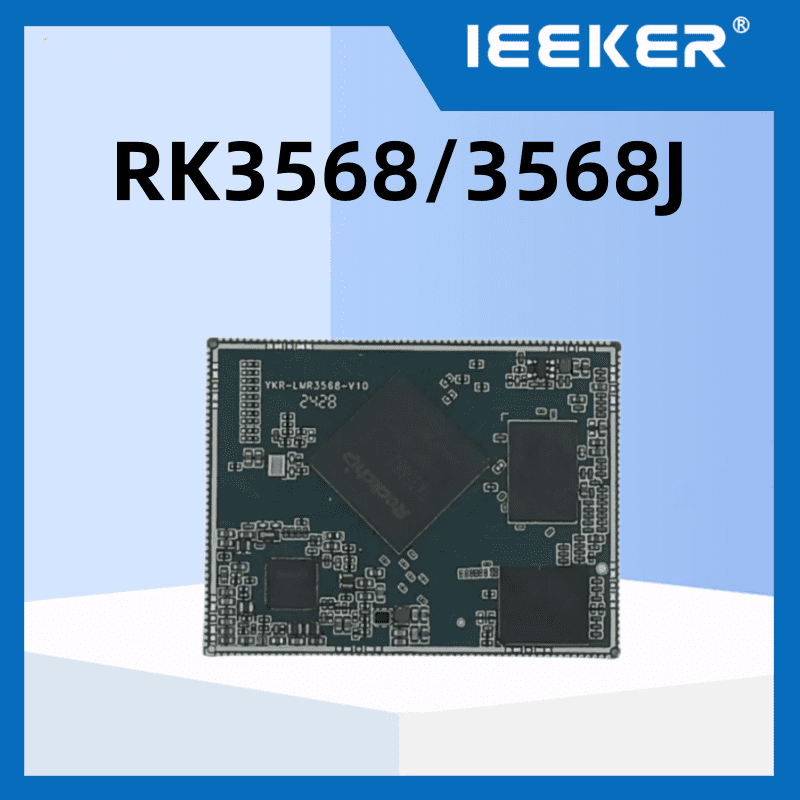
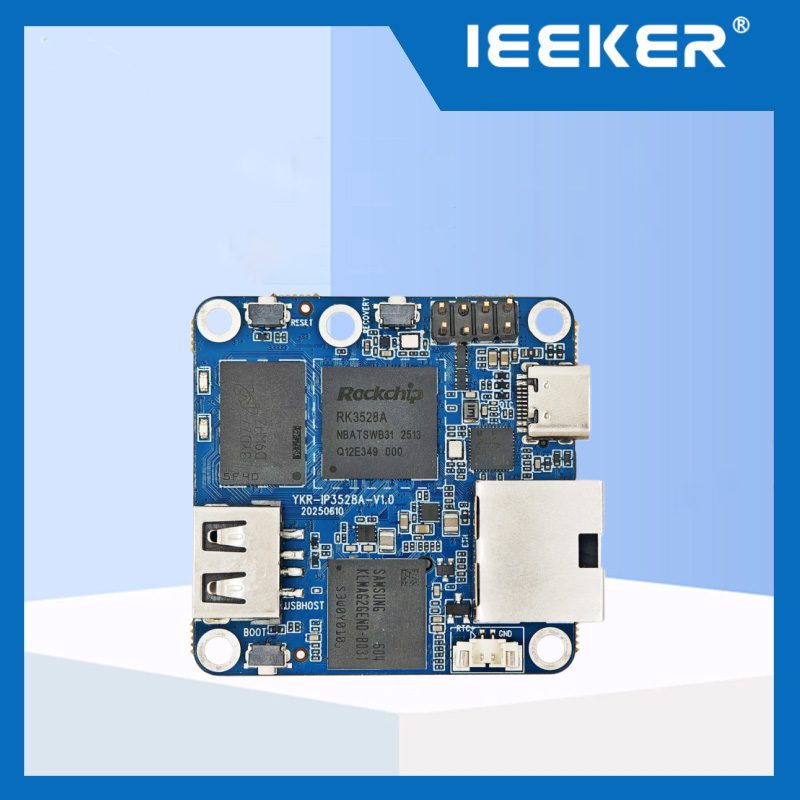
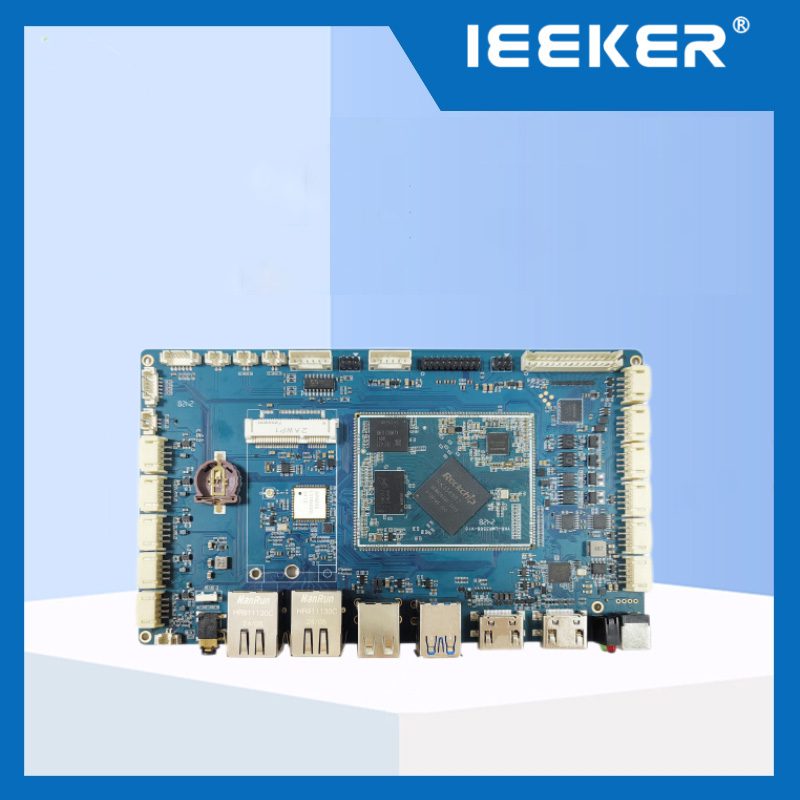
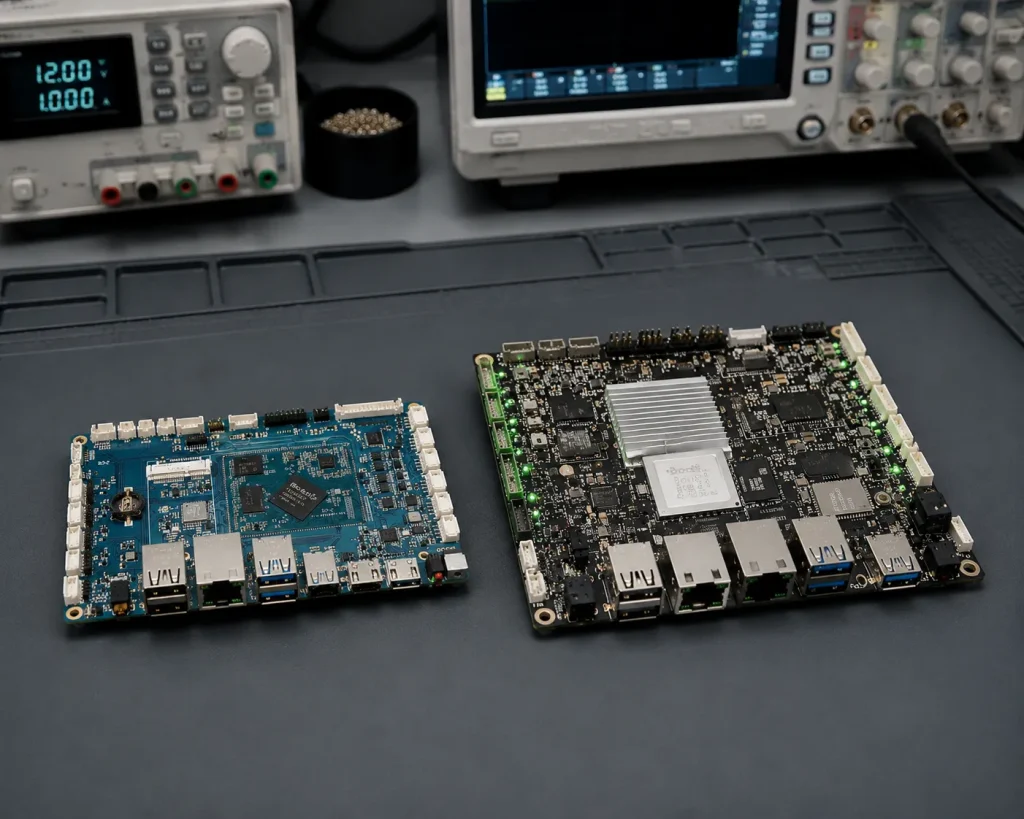
The RK3568 development board is the right choice for HMI panels, industrial IoT gateways, NVR systems, and cost-sensitive embedded deployments where 3–8W power consumption and 1 TOPS NPU are sufficient. The RK3588 development board is the right choice for edge AI inference, multi-camera machine vision, high-throughput computing, and applications where 6 TOPS NPU performance and octa-core processing are required. Both Rockchip SoCs run Android and Linux, share a mature BSP ecosystem, and are available in core board, SBC, and industrial motherboard form factors — the difference is entirely in compute headroom and BOM cost.
Key Takeaways
- RK3568: Quad-core Cortex-A55, 2.0GHz, 1 TOPS NPU, 22nm, 3–8W TDP — optimized for reliable mid-range embedded and industrial applications
- RK3588: Octa-core (4×A76 + 4×A55), 2.4GHz, 6 TOPS NPU, 8nm, 5–13W TDP — optimized for edge AI, machine vision, and high-performance embedded computing
- RK3568 is the dominant SoC for HMI, IoT gateway, NVR, industrial tablet, and vehicle control applications — the highest-volume industrial embedded segment
- RK3588 delivers 6x more AI compute than RK3568 (6 TOPS vs 1 TOPS) and roughly 2.5–3x single-thread CPU performance via Cortex-A76 cores
- Both SoCs support Android, Debian, Ubuntu, and Buildroot — OS choice is not a differentiator between them
- A custom development board or carrier board design can reuse significant schematic blocks between RK3568 and RK3588 platforms, reducing re-spin cost when upgrading
Why This Comparison Matters More Than RK3588 vs Raspberry Pi
The RK3588 vs Raspberry Pi comparison dominates embedded forums. But for industrial engineers and product managers actually specifying embedded development boards for real deployments, the more consequential decision is between RK3568 and RK3588 — both from Rockchip, both industrial-grade, both available in production-ready development board and core board configurations.
This decision touches budget, power budget, thermal design, OS stack, BSP maintenance lifecycle, and product scalability. Getting it wrong costs weeks of re-engineering. Getting it right means shipping a product with the right compute for its workload at the lowest sustainable BOM cost.
According to Rockchip’s official RK3568 datasheet , the RK3568 is explicitly positioned for industrial IoT, HMI, IoT gateways, cloud terminals, and NVR applications. The RK3588 is positioned for edge AI, high-performance computing, and multi-camera vision systems. These are not competing product lines — they are different tools for different jobs.This guide gives you the complete technical comparison, real deployment benchmarks, and a four-question framework to make the call quickly and confidently.
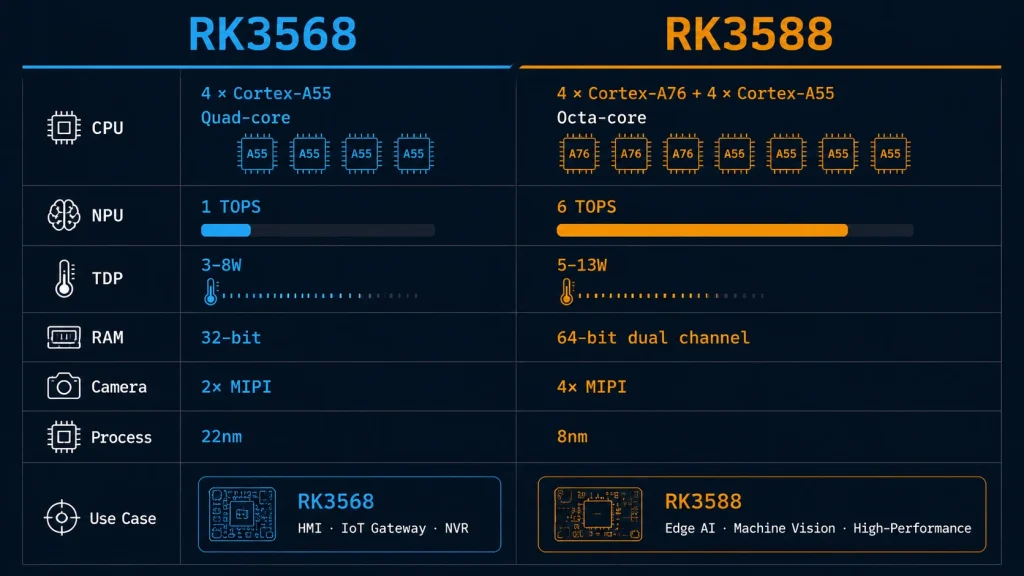
Full Specification Comparison: RK3568 vs RK3588 Development Board
| Specification | RK3568 Development Board | RK3588 Development Board |
|---|---|---|
| CPU Architecture | Quad-core Cortex-A55 | 4×Cortex-A76 + 4×Cortex-A55 |
| Max CPU Frequency | 2.0 GHz | 2.4 GHz (A76) / 1.8 GHz (A55) |
| Process Node | 22nm | 8nm |
| NPU Performance | 1 TOPS (INT8) | 6 TOPS (INT8) |
| GPU | Mali-G52-2EE | Mali-G610 MP4 |
| Max RAM | 8GB LPDDR4/LPDDR4X | 32GB LPDDR4X |
| Memory Bus | 32-bit single channel | 64-bit dual channel |
| eMMC Support | Up to 128GB | Up to 256GB |
| Video Decode | 4K@60fps H.265/H.264 | 8K@60fps / 4K@120fps H.265 |
| Video Encode | 1080P@60fps H.264 | 8K@30fps H.265 |
| Display Output | HDMI + MIPI-DSI + eDP (3 simultaneous) | HDMI 2.1 + DP + MIPI-DSI (4K+ multi) |
| MIPI CSI Camera | 2×MIPI CSI (up to 8MP each) | 4×MIPI CSI (up to 32MP) |
| PCIe | PCIe 3.0 ×1 + PCIe 2.1 ×2 | PCIe 3.0 ×4 (bifurcatable) |
| USB | USB 3.0 ×1 + USB 2.0 ×3 | USB 3.1 ×2 + USB 2.0 ×2 |
| Ethernet | 2× Gigabit (GMAC) | 2× 2.5Gbps (supported) |
| Industrial I/O | UART, SPI, I2C, GPIO, CAN, RS485, SATA | UART, SPI, I2C, GPIO, CAN, RS485, NVMe |
| Operating Temp | -40°C to 85°C (J-grade variant) | -40°C to 85°C (industrial config) |
| Typical TDP | 3–8W | 5–13W |
| Process Efficiency | Moderate (22nm) | High (8nm) |
| Relative BOM Cost | $$ (lower) | $$$ (higher) |
| OS Support | Android 11/12, Debian 11/12, Ubuntu, Buildroot | Android 12/13, Debian 12, Ubuntu 22.04, Buildroot |
| NPU Framework | RKNN-Toolkit (TF/PyTorch/ONNX/Caffe) | RKNN-Toolkit2 (TF/PyTorch/ONNX/Caffe) |
| Ideal Applications | HMI, IoT gateway, NVR, industrial tablet, vehicle control | Edge AI, machine vision, multi-camera systems, high-performance edge nodes |
Sources: Rockchip official datasheets; IEEKER product specifications; Forlinx Embedded Technology performance analysis
Understanding the CPU Difference: A55 vs A76
The most consequential hardware difference between these two development boards is not the NPU — it is the CPU architecture.
The RK3568 uses four Cortex-A55 cores. The ARM Cortex-A55 is a highly efficient microarchitecture designed for sustained, thermally stable performance in embedded and mobile applications. At 2.0GHz on a 22nm process, it delivers reliable throughput for HMI rendering, Modbus/MQTT protocol handling, video decoding, and general industrial control tasks — without requiring active cooling in most enclosure designs.
The RK3588 adopts an eight-core architecture featuring four high-performance Cortex-A76 cores and four power-efficient Cortex-A55 cores, while the RK3568 uses a four-core Cortex-A55 design — substantially improving processing speed for transaction handling, data processing, and compute-intensive workloads.
The Cortex-A76 in the RK3588 delivers approximately 2.5–3x the single-thread performance of an A55 at comparable clock speeds. For tasks that are single-threaded or lightly threaded — which describes most industrial control logic, HMI rendering, and protocol gateway work — this difference is largely irrelevant. For tasks that benefit from high single-core throughput — computer vision preprocessing, model inference scheduling, real-time video analytics — the A76 matters significantly.
The maximum theoretical TDP of the RK3588 exceeds 10W even at moderate clock speeds, whereas the RK3568 rarely draws past 4–5W unless pushed hard. This power difference is the primary reason RK3568-based embedded development boards dominate sealed industrial enclosure applications where passive cooling is mandatory.
The NPU Gap: 1 TOPS vs 6 TOPS — When Does It Matter?
The NPU performance gap between these two development boards is the most-cited specification in comparison articles. But raw TOPS numbers require context to be useful.
The RK3568’s 1 TOPS NPU is adequate for:
- Simple object detection (MobileNetV1/V2 at 720P, 15–30 FPS)
- Face detection and basic facial recognition (single camera)
- Barcode and QR code recognition
- Basic anomaly detection on structured sensor data
- Keyword spotting and simple voice command recognition
The RK3568 has a less powerful 1 TOPS NPU paired to a quad-core Cortex-A55 CPU, but this combination is still capable of developing NVRs and handling moderate AI workloads in IoT applications.
The RK3588’s 6 TOPS NPU is required for:
- Real-time object detection with YOLOv5s/YOLOv8n at 50+ FPS
- Multi-camera simultaneous inference (4–8 streams)
- Bearing and surface defect detection at production-line speeds
- Lightweight LLM inference (TinyLlama 1.1B at 10–15 tokens/s)
- Complex classification models (ResNet50, EfficientNet) at real-time rates
For the majority of industrial IoT gateway, HMI panel, and NVR applications — which represent the largest segment of embedded development board deployments — the RK3568’s 1 TOPS NPU is not a bottleneck. The bottleneck is more often network bandwidth, display rendering, or storage I/O. Only when the application’s AI inference requirement exceeds what 1 TOPS can deliver does the RK3588 become necessary.
Review our detailed RK3588 NPU performance guide for full benchmark data including YOLOv5, ResNet18, and bearing defect detection results on the 6 TOPS NPU.
Where RK3568 Development Boards Win
Industrial HMI Panels and Touch Displays
The RK3568’s Mali-G52 GPU drives 1080P displays smoothly, and its wide-temperature support ensures reliability on factory floors — making it ideal for basic HMI (Human-Machine Interface) applications such as industrial touchscreens for equipment status monitoring.
The RK3568 supports three simultaneous display outputs (HDMI + MIPI-DSI + eDP), which covers virtually every industrial HMI configuration from single-panel operator terminals to dual-screen kiosk setups. Rockchip’s new generation AIoT processor RK3568, a professional universal SoC based on advanced 22nm processing technology, can be widely used in industrial internet, HMI, NVR storage, vehicle central control, and industrial gateway applications.
For HMI applications running Qt or Android-based interfaces, the RK3568’s GPU is sufficient and its lower power draw (3–8W) makes passive cooling in slim panel enclosures straightforward. An RK3588 in this same application wastes 30–50% of its compute budget while costing more and requiring more thermal management.
IoT Gateways and Protocol Bridges
The RK3568’s 1× Gigabit Ethernet and RS485 ports enable seamless data transmission to cloud platforms, while its 3–8W power consumption supports battery-powered deployments such as wireless environmental monitors.
Industrial IoT gateways need dual Ethernet (the RK3568 has 2× GMAC), serial interfaces (RS232, RS485, CAN), and reliable Linux BSP support — not 6 TOPS of AI compute. The RK3568 checks every box for a Modbus-to-MQTT protocol bridge, a LoRa-to-cloud aggregation node, or a multi-protocol industrial gateway. Its 22nm process and lower power draw also mean longer MTBF in thermally challenging outdoor enclosures.
For IoT gateway applications, the RK3568 development board is the correct platform — and using an RK3588 would represent significant over-specification and unnecessary BOM cost increase.
NVR Systems and Multi-Channel Video Recording
The RK3588 SoCs are the most powerful of the three for NVR development, but the RK3568 can be used to develop medium or low-end solutions to serve customers who don’t need the most powerful NVRs for their respective applications.
For 4–8 channel 1080P NVR systems, the RK3568 handles video decoding (4K@60fps H.265) and storage management efficiently within its power budget. Its dual GMAC interfaces support PoE camera networks, and its SATA interface enables direct-attached storage for local recording. The RK3588 is warranted for NVR systems requiring 16+ channel simultaneous recording with AI analytics on every stream.
Vehicle Control Units and In-Vehicle Infotainment
The RK3568J variant (J-grade, automotive-oriented) is specifically validated for automotive temperature ranges. RK3568J is a high-performance and low-power quad-core application processor designed for industrial mobile internet devices and AIoT equipment, which can be applied to IoT devices, industrial control equipment, vending machines, commercial display equipment, and other outdoor applications in high or low temperature environments.
For vehicle dashboards, fleet telematics units, and in-vehicle infotainment systems, the RK3568 development board provides sufficient processing for multimedia playback, CAN-FD communication, and GPS/LTE integration — at a power envelope compatible with automotive power supply constraints.
Where RK3588 Development Boards Win
Edge AI and Deep Learning Inference
When your embedded application’s primary workload is running deep learning models — object detection, image classification, pose estimation, anomaly detection — the RK3588’s 6 TOPS NPU is the defining advantage over the RK3568.
The RK3588 delivers up to 6 TOPS INT8 versus just 0.8–1 TOPS on RK3568. Memory interface: LPDDR4X dual-channel at 3200 MT/s on RK3588 versus single-channel DDR4/LPDDR4 at 2400 MT/s on RK3568 — these differences compound significantly under demanding AI workloads.
For a machine vision inspection system running YOLOv8n at 60+ FPS, or a facial recognition node processing multiple simultaneous video streams, the RK3568’s NPU reaches its ceiling quickly. The RK3588 provides the headroom to run larger models, process higher-resolution inputs, and handle multiple concurrent inference tasks without frame dropping or latency spikes.
See our complete guide on RK3588 machine vision and defect detection for real benchmark data on industrial inspection applications.
Multi-Camera Vision Systems
The RK3588’s camera architecture is fundamentally more capable: 4×4-lane MIPI CSI interfaces supporting sensors up to 32MP, versus the RK3568’s 2×MIPI CSI supporting up to 8MP each. Combined with the dual-ISP (capable of handling 32MP sensors with hardware noise reduction and HDR), the RK3588 development board supports camera configurations that simply cannot run on an RK3568.
For products embedding multiple cameras — drone payloads, robotics vision heads, multi-angle inspection stations, smart traffic cameras — the RK3588 is the only viable choice between the two platforms.
High-Throughput Compute Nodes
Applications requiring sustained multi-threaded compute — real-time signal processing, concurrent protocol handling across dozens of connections, complex simulation, or LLM-assisted edge intelligence — benefit from the RK3588’s A76 cores in ways the RK3568 cannot match.
Complex IIoT gateways managing large-scale sensor networks of 50+ devices with edge analytics benefit from the RK3588’s NVMe storage for local caching of 100GB+ sensor data, and its PCIe 3.0 slot enables 5G modem expansion for remote sites with poor wired connectivity.
For edge computing nodes that aggregate data from large sensor networks, apply ML-based anomaly detection, and stream processed results to cloud or local SCADA systems, the RK3588’s memory bandwidth (64-bit dual-channel LPDDR4X at 3200 MT/s) and PCIe 3.0 connectivity provide sustained throughput that the RK3568 cannot sustain under heavy concurrent load.
Premium Kiosks and 4K Interactive Displays
With the demand for high-definition and diverse user interfaces, the RK3588 integrates the advanced Mali-G610 MP4 GPU, which compared to the Mali-G52 GPU in the RK3568, supports 4K ultra-HD displays and complex animations and graphics — allowing kiosks and terminals to deliver crisp, high-definition content and 3D product displays.
For flagship retail kiosks, interactive signage systems, and medical terminal displays requiring 4K UI rendering with smooth animation, the RK3588’s Mali-G610 GPU and 8K-capable display pipeline are warranted. For standard 1080P HMI and signage, the RK3568 is sufficient and more cost-effective.
Head-to-Head Benchmark: Performance at Real Workloads
| Workload | RK3568 Board | RK3588 Board | Verdict |
|---|---|---|---|
| 1080P H.265 Video Decode | ✅ 4K@60fps capable | ✅ 8K@60fps capable | RK3568 sufficient for ≤4K |
| YOLOv5s Object Detection | ~8–12 FPS (NPU) | ~54 FPS (NPU) | RK3588 required for real-time |
| MobileNetV2 Classification | ~40–60 FPS (NPU) | ~200 FPS (NPU) | RK3568 sufficient for basic AI |
| Simultaneous Camera Streams | 2 cameras (MIPI) | 4–8 cameras (MIPI) | RK3588 for multi-camera |
| HMI Qt 1080P Rendering | ✅ Smooth | ✅ Smooth | RK3568 sufficient, lower cost |
| Modbus/MQTT Gateway | ✅ Optimal | ✅ Overkill | RK3568 is the right choice |
| NVR 8-channel 1080P | ✅ Capable | ✅ With headroom | RK3568 sufficient |
| Memory Bandwidth | ~12–15 GB/s | ~34–38 GB/s | RK3588 for bandwidth-heavy AI |
| Passive Cooling Viability | ✅ Yes (3–8W) | ⚠️ Possible with optimization | RK3568 easier to cool passively |
| Multi-Display (3 simultaneous) | ✅ Supported | ✅ Supported (up to 4K) | RK3588 for 4K+ requirement |
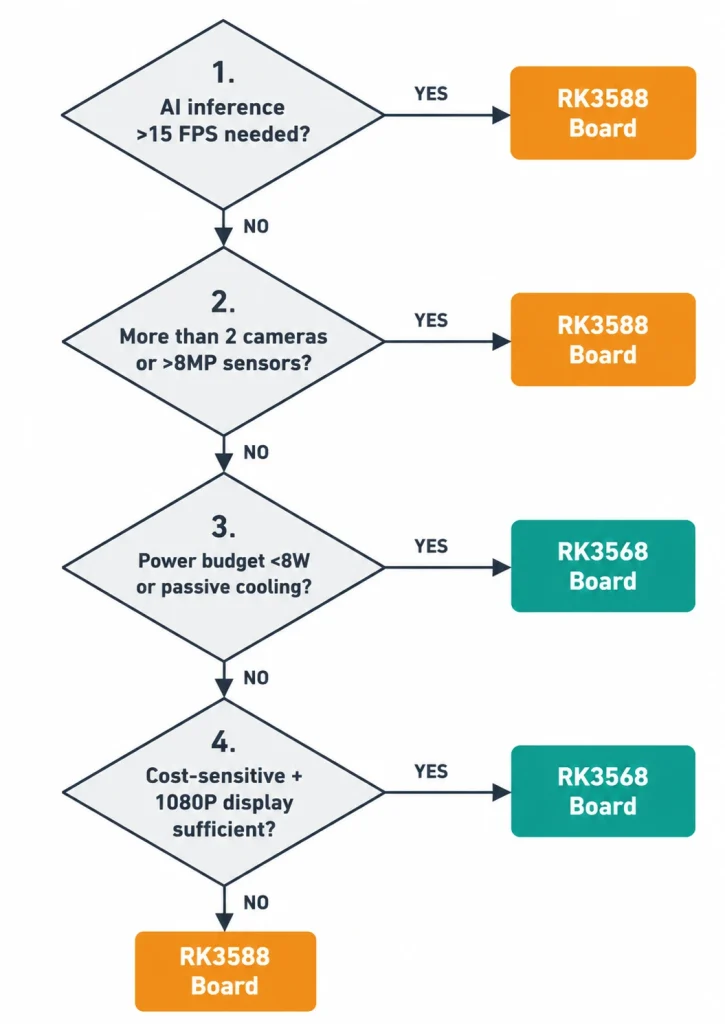
Decision Framework: 4 Questions to Choose Your Development Board
This framework is based on the selection criteria used across dozens of industrial embedded deployments. Answer the four questions in order — the first question that gives you a definitive answer is your stopping point.
Q1. Does your application require AI inference at more than 15 FPS on models larger than MobileNetV2? → Yes → RK3588 development board → No / AI is not a primary workload → continue to Q2
Q2. Does your product require more than 2 simultaneous camera inputs or sensors above 8MP? → Yes → RK3588 development board → No → continue to Q3
Q3. Is your power budget under 8W, or is passive cooling in a sealed enclosure required? → Yes → RK3568 development board → No (active cooling is acceptable) → continue to Q4
Q4. Is BOM cost optimization a primary constraint, and is 1080P display resolution sufficient? → Yes → RK3568 development board → No (4K display or higher compute needed) → RK3588 development board
If your answers split — for example, you need passive cooling (pointing to RK3568) but also need 30+ FPS object detection (pointing to RK3588) — the correct path is optimizing your model architecture for RK3568’s 1 TOPS NPU using INT8 quantization and lightweight backbones (MobileNetV3, EfficientDet-lite), or accepting active cooling in the enclosure design and stepping up to RK3588.
From the Factory Floor: The Wrong Board Choice and How We Fixed It
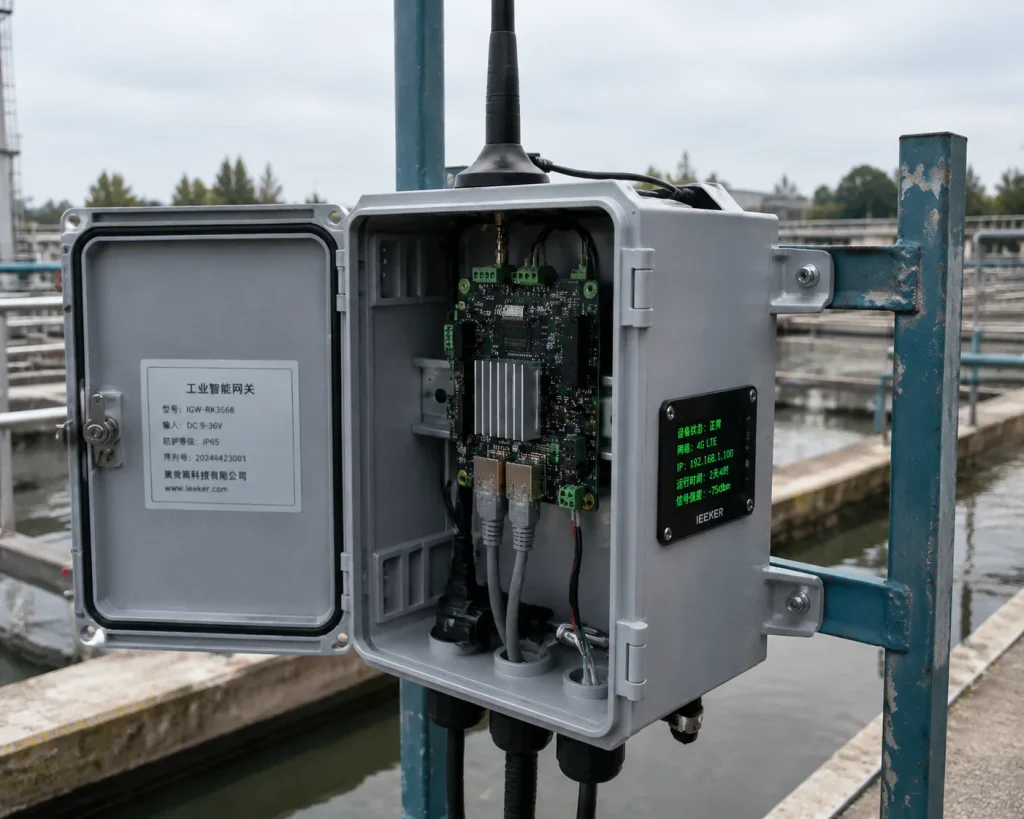
First-person account from IEEKER’s embedded systems engineering team.
A customer building a distributed water quality monitoring gateway came to us with a prototype based on an RK3588 development board. The application: aggregating data from 24 water sensors across a treatment plant, running threshold-based anomaly alerts, packaging data into MQTT payloads, and transmitting to a cloud dashboard every 30 seconds. The software stack was Python-based, running on Ubuntu 22.04.
The system worked perfectly in the lab. In the field enclosure — an IP65-rated aluminum box mounted outdoors on a pipe rack — it did not. The RK3588’s 5–13W power draw, combined with summer ambient temperatures of 42°C at the installation site, caused the SoC to throttle CPU frequency after 2–3 hours of operation. The cloud data stream became intermittent. The customer’s field team was making weekly site visits to manually restart the gateway.
The root cause: the application’s computational requirements were trivially light — MQTT aggregation and simple threshold math requires less than 5% CPU utilization on any modern SoC. But the RK3588’s power management in this idle-but-connected state still drew 6–8W, which the enclosure’s passive thermal design could not sustain at high ambient.
We replaced the RK3588 development board with ieeker’s RK3568 industrial SBC. The identical application ran with 2–3W average power draw. Peak temperature inside the enclosure dropped 18°C. In eight months of continuous field operation across 12 installations, zero thermal-related incidents were recorded. The BOM cost per gateway unit also dropped by approximately 35%.
The lesson: development board selection is not a prestige decision. The right board is the one whose compute profile matches the application’s actual requirements — not its theoretical ceiling.
Project Case Study: RK3568 Industrial Tablet for Factory Floor Operator Terminals
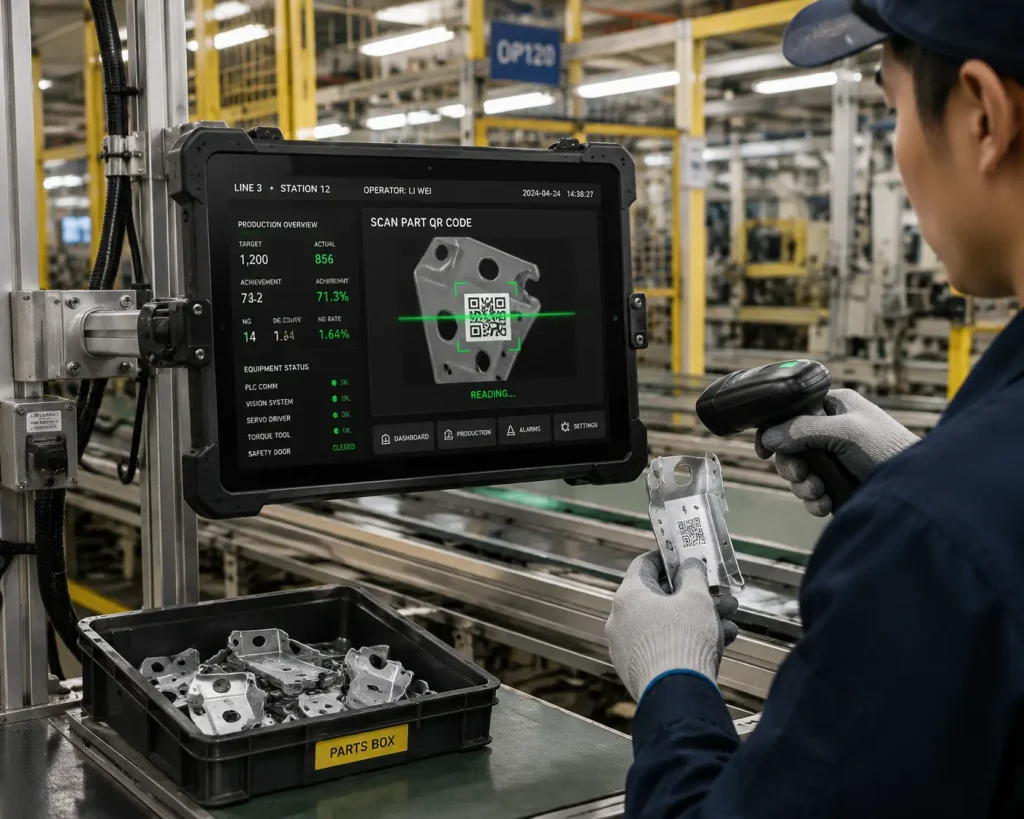
RK3568 embedded development board deployment, 60-unit rollout, automotive component manufacturing.
In mid-2024, an automotive component manufacturer required ruggedized operator terminals for 60 production line stations across three factory buildings. Each terminal needed to display real-time production data from a SCADA system, allow operators to log quality observations via touchscreen, scan QR codes on components, and alert supervisors via a local WiFi-connected messaging system. The display requirement was 10.1-inch 1080P capacitive touch.
The initial specification requested RK3588-based tablets, based on the assumption that “more performance is always better.” After a technical review, we recommended an RK3568-based industrial development board platform instead.
The reasoning: the application’s peak computational requirement was rendering a SCADA web dashboard in a Chromium-based browser, running a QR code scanning library in background, and maintaining a WebSocket connection. Total CPU utilization in testing: under 12% of the RK3568’s quad-core A55. GPU utilization: under 8% for 1080P UI rendering. NPU: unused.
Results from 60-unit deployment, 90-day production operation:
| Metric | Target | Achieved |
|---|---|---|
| Boot-to-operational time | <30s | 18s (Debian 12, optimized) |
| Continuous operation temp | <65°C SoC | 51°C average (passive cooling) |
| Unplanned downtime (90 days) | <2 hours/unit | 0 hours across all 60 units |
| SCADA page load time | <2s | 0.9s average |
| QR scan response time | <500ms | 180ms average |
| BOM cost vs RK3588 platform | — | 38% reduction |
| Battery life (optional battery config) | 8 hours | 11.2 hours |
The 38% BOM reduction across 60 units translated to direct capital savings that allowed the customer to add a secondary display to 20 supervisor stations — a feature previously considered out of budget.
RK3568 vs RK3588: Form Factors Available for Industrial Deployment
Both SoCs are available in all three major industrial embedded form factors. Understanding which form factor matches your project scope is as important as the SoC selection itself.
Core Board (SoM — System on Module)
A core board integrates the SoC, RAM, eMMC, and power management into a compact, solderable or connector-mounted module. Your team designs a custom carrier board with the specific I/O configuration your product requires.
RK3568 core boards: Typically 45×45mm to 70×40mm. Used in IoT gateways, HMI controllers, industrial tablets, and NVR systems where the carrier board is product-specific. IEEKER’s RK3568 core board supports SODIMM connector interface for rapid carrier board development.
RK3588 core boards: Slightly larger due to higher layer count and thermal requirements. Used in machine vision head units, edge AI inference modules, and high-performance embedded computers.
Both form factors are covered in our SoM vs SBC guide for a detailed discussion of when each form factor is appropriate for industrial deployments.
Single-Board Computer (SBC / Development Board)
An SBC integrates core board functionality with a standard carrier board, providing a complete development and production-ready platform without custom hardware design. This is the fastest path from evaluation to production for applications where standard I/O configurations are sufficient.
RK3568 SBC: ieeker’s RK3568-based development boards include dual Gigabit Ethernet, USB 3.0, HDMI, MIPI, RS485, CAN, and SATA — covering the standard industrial connectivity matrix for HMI and gateway applications.
RK3588 SBC: ieeker’s RK3588 and RK3588S development boards add PCIe 3.0, dual 2.5G Ethernet, NPU-accelerated AI acceleration, and 4×MIPI CSI for multi-camera configurations. The YKR-3588S is compatible with Orange Pi 5/5B carrier boards, expanding accessory ecosystem options.
Industrial Motherboard
Industrial motherboards provide a full-featured, production-hardened platform with extended temperature support, wider input voltage range, and industrial-grade component selection. These are appropriate for long-lifecycle deployments (10–15 years) where component availability and BSP maintenance commitments matter.
ieeker’s industrial motherboard lineup covers both RK3568 and RK3588 SoCs with -40°C to 85°C operating temperature validation. For applications in harsh industrial environments — mining, oil and gas, outdoor infrastructure — the industrial motherboard form factor provides reliability margins that standard development boards cannot offer.
Software and BSP: Are They Equivalent?
For most development teams, BSP compatibility is as important as hardware specs. Here is the honest comparison.
OS Support: Both RK3568 and RK3588 run Android 11/12, Debian 11/12, Ubuntu 20.04/22.04, and Buildroot. There is no meaningful OS ecosystem difference between the two platforms.
RKNN Framework: RK3568 uses RKNN-Toolkit (the first-generation Rockchip NPU SDK). RK3588 uses RKNN-Toolkit2 (second-generation, with better quantization tools and broader model support). Both support TensorFlow, PyTorch (via ONNX), Caffe, and MXNet model conversion. RKNN-Toolkit2 is the more capable tool, but for the AI workloads appropriate to the RK3568’s 1 TOPS NPU, RKNN-Toolkit is sufficient.
Driver Maturity: The RK3568 has been in production since 2021 and has a highly mature BSP. Community support, forum answers, and third-party driver availability are excellent. The RK3588 BSP is also mature as of 2023+, with strong community adoption driven by Orange Pi 5 and similar popular SBCs.
Long-Term BSP Support: ieeker commits to BSP maintenance for both platforms across 10-year product lifecycles. For industrial deployments with 7–10 year product horizons, both platforms have equivalent lifecycle commitments at the manufacturer level.
For OS selection guidance applicable to both platforms, refer to our Linux vs Android on RK3588 guide — the decision framework applies equally to RK3568-based development boards.
ODM/OEM Custom Development Board: RK3568 or RK3588 as Your Base?
For companies building custom embedded products — industrial controllers, smart terminals, specialized gateways — the choice between RK3568 and RK3588 as the ODM base platform has long-term consequences beyond the first product revision.
RK3568 as custom development board base: Lower BOM cost per unit, simpler thermal design (often enabling thinner enclosures), well-understood power tree design, and proven high-volume manufacturing track record. Ideal for products where the core value proposition is connectivity, HMI, or protocol integration rather than AI compute.
RK3588 as custom development board base: Higher per-unit cost, more complex power delivery (requires more sophisticated PMIC configuration), greater thermal management attention, but provides AI compute headroom for future firmware-based feature additions. Ideal for products where AI capabilities will be expanded over the product’s lifetime, or where the AI compute is central to the product’s current value proposition.
Compared with the RK3588 family (higher performance, more PCIe lanes, larger memory support), the RK3568 keeps BOM and power budgets lower while still supporting Android and mainstream Linux distributions — a sweet spot for many commercial and industrial projects.
ieeker’s custom development board design service supports both platforms from schematic through production validation, including carrier board design for core board configurations, BSP customization, and regulatory certification support (CE, FCC, RoHS).
Frequently Asked Questions
Can I run the same software stack on both RK3568 and RK3588?
Yes, with minor modifications. Both run the same Linux distributions and Android versions. Application code written for RK3568 Debian/Ubuntu will run on RK3588 with minimal porting effort — primarily recompiling for the A76 instruction set and updating any RKNN model files to RKNN-Toolkit2 format. The reverse (RK3588 to RK3568) requires the same plus ensuring model complexity is within the 1 TOPS NPU’s capacity.
Is the RK3568J different from the standard RK3568?
Yes. The RK3568J is the industrial-grade variant with extended temperature validation and enhanced ECC memory support. The RK3568B2 is a cost-optimized variant with reduced interface count. For industrial deployments, the RK3568J is the correct variant. ieeker’s industrial development boards and core boards use the J-grade variant for -40°C to 85°C applications.
Can I upgrade from RK3568 to RK3588 without redesigning my carrier board?
Partially. Both SoCs share some pin-compatible signals, but the power delivery requirements, PCIe configuration, and memory interface differ enough that a full carrier board redesign is typically required. However, the schematic architecture (power tree topology, peripheral interface patterns) can be reused significantly, reducing re-spin effort. ieeker’s engineering team supports platform migration projects as part of the custom development board service.
Which platform is better for RISC-V integration or heterogeneous computing?
Neither RK3568 nor RK3588 includes a RISC-V core. Both are pure ARM platforms. For heterogeneous embedded designs requiring RISC-V microcontroller integration (for real-time control loops), external RISC-V MCUs (e.g., CH32V series) can be connected via SPI or UART to either platform. ieeker’s R&D team actively monitors RISC-V developments — see our about page for our technology roadmap focus areas.
What certifications are available for ieeker's RK3568 and RK3588 development boards?
IEEKER’s industrial boards support CE, FCC, and RoHS compliance pathways. The R&D center includes EMC laboratory facilities for pre-certification testing. For ODM/OEM projects requiring specific regional certifications, contact the engineering team to discuss certification scope during the design phase.
Conclusion: Choose the Board That Matches the Workload, Not the Spec Sheet
The RK3568 vs RK3588 development board decision comes down to one discipline: matching compute to workload. The RK3568 is not the “cheaper, worse” option — it is the correctly specified option for the majority of industrial IoT gateways, HMI panels, NVR systems, and embedded controller applications that make up the high-volume industrial embedded market.
The RK3588 is not overkill — it is precisely specified for edge AI inference, multi-camera vision systems, and high-throughput embedded computing nodes where its 6 TOPS NPU and octa-core CPU are genuinely utilized.
Use the 4-question decision framework above before finalizing your development board selection. If you are at the prototype stage and uncertain, ieeker’s engineering team can review your application requirements and recommend the right platform — including evaluation board configurations that let your software team validate the selection before committing to a production BOM.
Explore IEEKER's RK3568 and RK3588 Development Board Lineup
Whether your project calls for the efficiency of the RK3568 or the AI compute of the RK3588, ieeker offers production-ready development boards, core boards, and industrial motherboards for both platforms — backed by 18 years of embedded systems manufacturing experience and a 10-year lifecycle commitment.
Ready to choose your platform? Here are your next steps:
→ Browse RK3568 boards: ieeker RK3568/RK3568J product page — core boards, development boards, and industrial motherboard configurations
→ Browse RK3588 boards: ieeker RK3588 product page — including the YKR-3588S with Orange Pi 5 compatibility and the full RK3588 industrial SBC lineup
→ Need a custom design? Our ODM/OEM custom development board service handles full hardware and BSP customization for both platforms, from schematic to mass production
→ Have a specific use case? Contact ieeker’s engineering team with your application requirements — we’ll recommend the right platform, walk you through evaluation board options, and support your technical integration from first prototype to production shipment
→ Explore application scenarios: Our applications page covers Edge AI, Robotics, Medical, Smart Transportation, Smart City IoT, Smart Retail, Energy/BESS, and Smart Agriculture — with platform recommendations for each vertical
The right embedded development board is not the most powerful one available. It is the one your product actually needs. Let’s help you find it.
Sources and References:
- Rockchip RK3568 Brief Datasheet — rock-chips.com
- RK3568 Performance Analysis — Forlinx Embedded Technology
- RK3568 vs RK3588 vs RK3576 Industrial Selection Guide — FR4PCB.TECH
- RK3568 vs RK3588 Comparative Analysis — UIPOS
- ARM Cortex-A55 Architecture — Wikipedia
- Rockchip RK3568 for NVR Development — Dusun IoT
- RK3568 Tablet Customization Guide — Rockchips.net
- RKNN-Toolkit2 — Rockchip GitHub