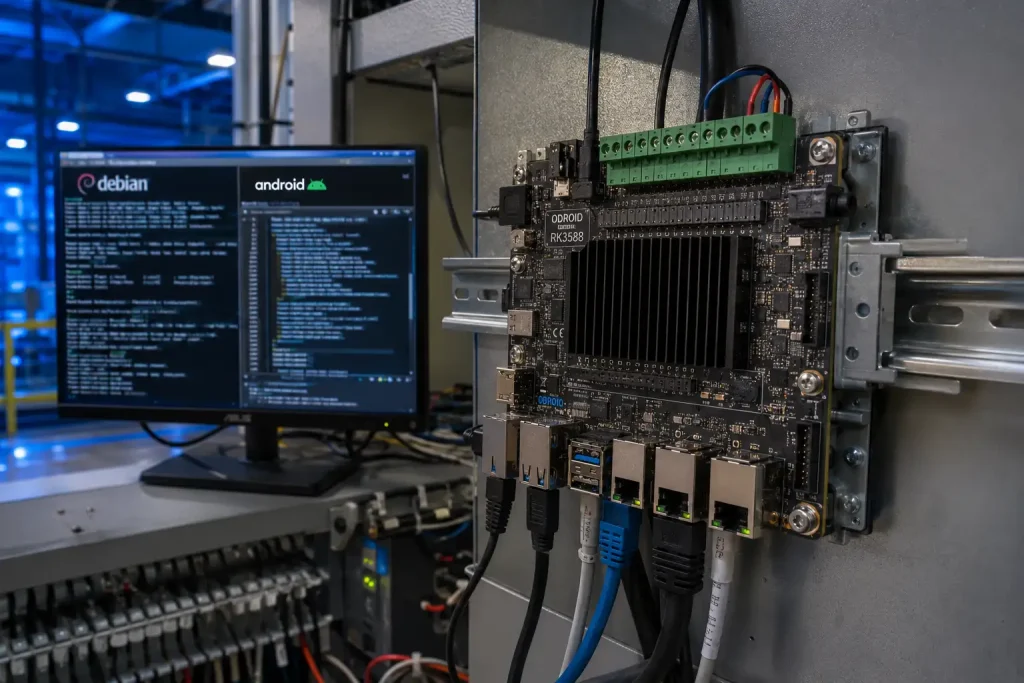
Answer Summary: For most industrial deployments on RK3588, Linux (Debian, Buildroot, or Ubuntu) offers better kernel control, faster boot times, and longer lifecycle support. Android is a strong choice only when your product requires a rich touch UI and your development team is mobile-app-oriented. The right answer depends on four specific project parameters — covered in the decision framework below.
Key Takeaways
- Linux holds 46% developer adoption among embedded/IoT engineers in 2024, the highest of any embedded OS (Eclipse Foundation)
- Android on RK3588 is well-suited for HMI panels, kiosks, and digital signage — but carries hidden costs in headless or real-time deployments
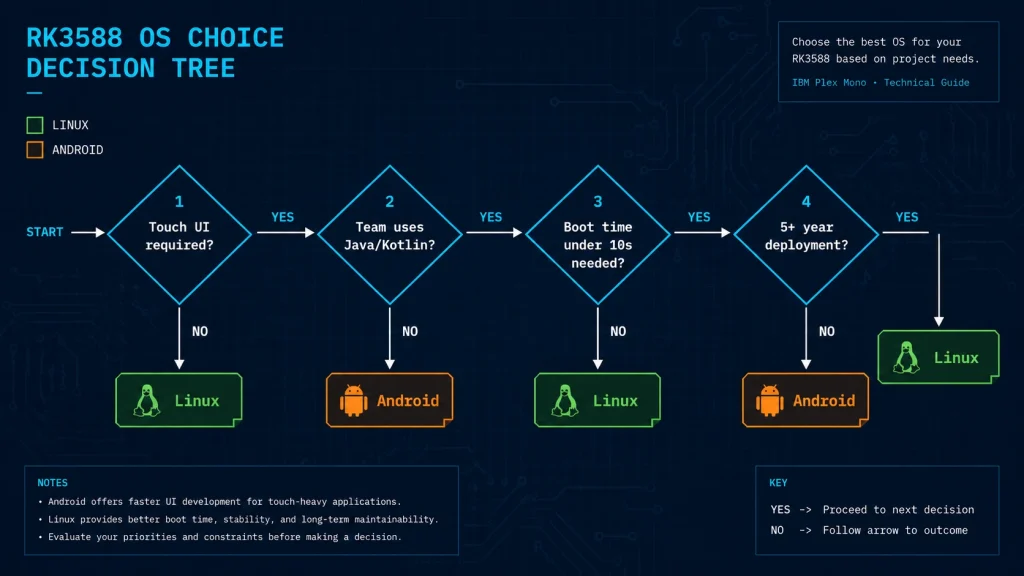
- Linux (with PREEMPT-RT patch) achieves sub-10s boot and soft real-time performance; Android typically boots in 20–45 seconds
- Buildroot produces the leanest images for mass production; Debian is the best developer experience; Ubuntu has the broadest community support
- Both OSes support Rockchip’s RKNN-Toolkit2 for NPU inference — this is not a differentiator
- Our 4-question decision framework helps you make the call in under 5 minutes
What OS Options Does RK3588 Actually Support?
The RK3588 Linux vs Android choice starts with understanding what’s actually on the table. Rockchip’s BSP (Board Support Package) supports a broader OS ecosystem than most engineers realize when they first spec a board.
Linux distributions officially supported on RK3588:
| Distribution | Best For | Image Size | Customization |
|---|---|---|---|
| Buildroot | Mass production, minimal footprint | ~50–200MB | Extremely high |
| Debian 11/12 | Development, lab prototyping | ~1–2GB | High |
| Ubuntu 22.04 | Broad developer community, quick start | ~1.5–3GB | High |
| Yocto | Custom embedded Linux, full control | Configurable | Extreme |
| RTLinux / PREEMPT-RT | Soft real-time industrial control | Varies | High |
Android options on RK3588:
- Android 12 AOSP (most common for industrial boards)
- Android 13 AOSP (available on select BSPs)
Note: Android Things was officially discontinued by Google in January 2022 and should not be considered for new designs.
Both OS families support Rockchip’s RKNN-Toolkit2 for NPU inference, meaning AI acceleration is not an OS-dependent decision on RK3588.
Linux on RK3588 — What It’s Actually Good At
Linux dominates industrial embedded deployments for a reason.According to a 2025 market analysis, embedded Linux maintains 46% developer adoption across IoT and embedded projects — the highest of any OS in the Eclipse Foundation’s annual survey. For RK3588-based industrial boards specifically, that advantage compounds across several dimensions.
Full Kernel Control and Driver Customization
When your product uses non-standard peripherals — a proprietary CAN bus interface, a custom MIPI sensor, or an RS-485 module — Linux gives you complete access to the kernel source. You can write or modify drivers directly, use device tree overlays, and build a BSP that maps precisely to your hardware.
Buildroot and Yocto take this further by letting you define exactly which packages ship in the final image. A production unit running a machine vision pipeline doesn’t need a desktop environment, a browser, or a Bluetooth stack. On Linux, you strip them. On Android, AOSP’s component dependencies make this significantly harder without deep platform engineering.
Headless and Server-Side Deployments
If your RK3588 board is running as an edge inference server, an industrial gateway, or a vision processing node — with no display attached — Linux is the only sensible choice. Android requires a display framework to boot properly and is fundamentally designed around a graphical interaction model. Running it headless means fighting the OS rather than working with it.
Linux handles headless deployments natively. SSH access, systemd services, watchdog daemons, and remote OTA update tools like SWUpdate or Mender all integrate cleanly into Debian or Buildroot environments.
Long-Term Lifecycle and BSP Maintenance
Industrial products often ship for 5–10 years. The International Electrotechnical Commission (IEC) reported that 48% of newly deployed industrial control systems in 2023 integrated embedded Linux specifically because of its long-term stability profile. Linux kernel LTS (Long Term Support) branches receive security patches for 6+ years. Suppliers like ieeker commit to traceable kernel maintenance — meaning you can audit every change to the BSP over the product’s lifetime.
Android’s security update model is tied to Google’s release schedule, and OEM boards often lag by 6–18 months. For a product with a 7-year deployment window, this creates compounding maintenance risk.
Real-Time Requirements
Standard Linux is not a real-time OS. This is a common misconception that leads engineers to assume Android and Linux are equivalent for time-sensitive control loops. They are not — and neither is Android, which does not support real-time execution at the kernel level.
For soft real-time requirements (latency targets in the 1–10ms range), Linux with the PREEMPT-RT patch delivers deterministic enough performance for motor control interfaces, sensor polling loops, and PLC-style automation. For hard real-time requirements (sub-millisecond determinism), a dedicated RTOS like FreeRTOS or Zephyr running alongside Linux via AMP (Asymmetric Multi-Processing) is the correct architecture — not Android.
Android on RK3588 — When It Actually Makes Sense
Android isn’t the wrong choice for RK3588 — it’s the wrong choice for most industrial applications. In the specific scenarios where it fits, it fits well.
Touch UI and Kiosk Applications
Android’s strongest industrial case is a product that looks and feels like a tablet. HMI panels on factory floors, retail kiosks, digital signage controllers, and patient-facing medical terminals all benefit from Android’s mature touch framework, animation engine, and app ecosystem.
Advantech, one of the world’s largest industrial computing vendors, ships a significant portion of its HMI and kiosk product line on Android — specifically because the target end-users are non-technical operators who expect a smartphone-like interaction model.
Building the equivalent UI on Linux requires a framework choice (Qt, GTK, or a web-based stack like Chromium Embedded), longer development time, and more specialized engineers. For products where the UI is the product, Android is a legitimate shortcut.
Familiar Development Stack for App Teams
If your software team comes from mobile development — Java, Kotlin, Android Studio — the ramp-up time on embedded Linux is significant. Setting up a cross-compilation toolchain, writing device tree overlays, and debugging kernel panics over UART is a steep learning curve for developers who have never left the Android SDK.
For startups and product teams who need to ship fast and have mobile talent, Android on RK3588 can cut 4–8 weeks off initial development time. The trade-off becomes clear later, at the integration and productionization stage.
Android’s Hidden Costs in Industrial Settings
The honest assessment: Android carries real costs in industrial deployments that are rarely discussed upfront.
Boot time: Stock Android 12 AOSP on RK3588 typically boots in 25–45 seconds. Optimized builds can get to ~15 seconds with significant BSP engineering effort. Linux Buildroot images routinely boot in under 8 seconds with basic optimization.
AOSP customization: Removing Google services from AOSP is not trivial. The dependency graph between AOSP components is complex, and stripping it incorrectly breaks system stability. Industrial Android deployments typically require 2–4 months of AOSP platform engineering before the OS is suitable for the product.
No native real-time support: As noted above, Android runs on the Linux kernel but does not expose real-time scheduling interfaces in a way that’s useful for deterministic control loops.
Long-term update dependency: AOSP security patches come from Google on a monthly schedule, but hardware vendors rarely backport them to industrial BSPs at the same cadence.
Head-to-Head Comparison: Linux vs Android on RK3588
| Dimension | Linux (Debian / Buildroot) | Android 12 AOSP |
|---|---|---|
| Boot Time | 5–15s (optimizable to <5s) | 20–45s (optimizable to ~15s) |
| Headless Deploy | ✅ Native | ❌ Requires workarounds |
| Real-Time Support | Soft RT via PREEMPT-RT | ❌ Not supported |
| UI Development | Qt / GTK / Web (CEF) | Native Android SDK |
| Dev Team Stack | C / C++ / Python | Java / Kotlin |
| NPU (RKNN-Toolkit2) | ✅ Full support | ✅ Full support |
| Kernel Customization | Extreme | Limited (AOSP constraints) |
| Production Image Size | 50MB–2GB (configurable) | 2–6GB minimum |
| Long-Term BSP Support | LTS kernel, 6+ year patches | Google-dependent cadence |
| Typical Use Cases | Edge AI, vision, gateways, IIoT | HMI, kiosks, digital signage |
| AOSP Strip-Down Effort | N/A | 2–4 months typical |
| Open Source License | GPL / MIT | Apache 2.0 (AOSP) |
Decision Framework: 4 Questions to Choose Your OS
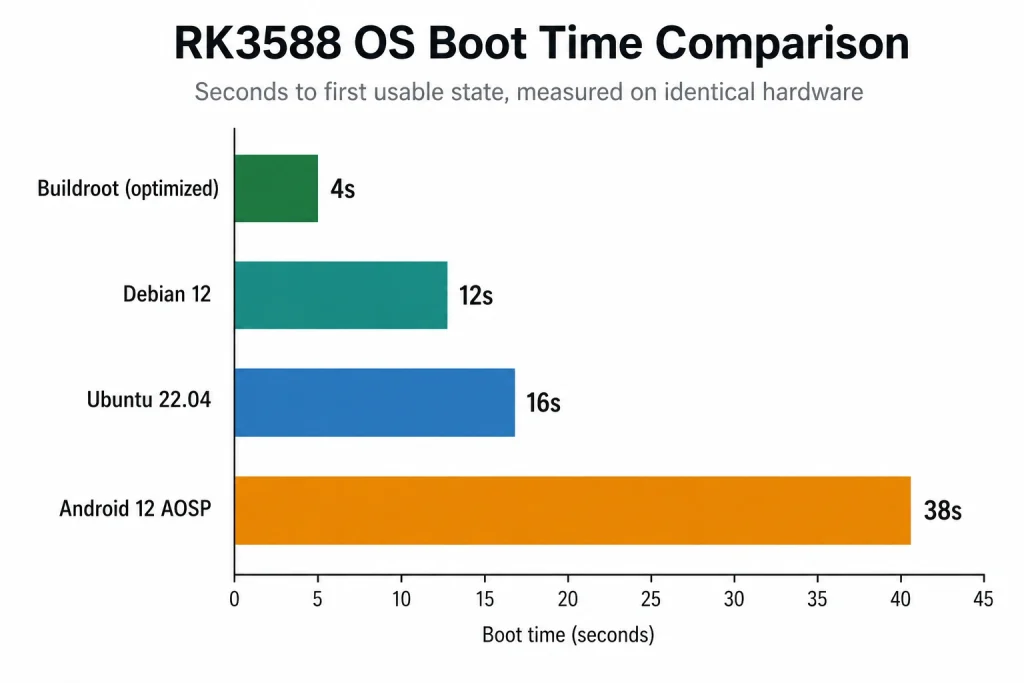
Rather than a generic recommendation, use these four questions to arrive at the right answer for your specific project. This framework is based on the decision criteria used across dozens of RK3588 industrial deployments.
Q1. Does your product require a consumer-style touch UI?
→ Yes, users expect app-like interactions → Android is worth evaluating
→ No, or the UI is minimal / web-based → Linux
Q2. What is your team’s primary development language?
→ Java / Kotlin, mobile background → Android reduces ramp-up time
→ C / C++ / Python, embedded background → Linux is the natural fit
Q3. Do you need sub-10s boot time or soft real-time response?
→ Yes (industrial control, instant-on kiosk, edge sensor node) → Linux + PREEMPT-RT
→ No (display-heavy dashboard, offline-capable kiosk) → Android acceptable
Q4. Is your deployment lifecycle 5 years or longer?
→ Yes → Linux — LTS kernel support, traceable BSP maintenance, no Google dependency
→ No, 2–3 year product cycle → Android viable if UI requirements match
If your answers split across OS boundaries (e.g., you need a touch UI and sub-5s boot), the answer is Linux with a Qt-based UI layer — a well-proven combination for industrial HMI applications.
Linux Distribution Choices on RK3588: Buildroot vs Debian vs Ubuntu
Once you’ve chosen Linux, the next decision is which distribution. Each has a distinct role in the product development lifecycle.
Buildroot generates a minimal root filesystem from source. There is no package manager, no unnecessary services, and no wasted flash storage. A Buildroot image for a vision processing node might be 80–150MB and boot in under 5 seconds. It is the right choice for mass production where every megabyte and every boot second matters. The trade-off: initial setup takes longer and adding packages later requires rebuilding the image.
Debian 11/12 is the most developer-friendly Linux distribution for RK3588. apt package management makes it easy to install OpenCV, TensorFlow Lite, GStreamer, and thousands of other libraries without cross-compilation. SSH access and a familiar file structure mean engineers from any Linux background can be productive on day one. Debian is ideal for development, validation, and low-to-mid volume production where flash storage is not constrained.
Ubuntu 22.04 shares Debian’s ease of use and adds the largest community support base of any Linux distribution. Stack Overflow answers, GitHub issues, and community BSP patches are more readily available for Ubuntu than any other Linux variant. For teams new to embedded Linux, Ubuntu minimizes “where do I find help?” friction.
A typical project uses Ubuntu or Debian during development, then migrates to a Buildroot production image after the software stack is stable. This workflow is well-supported on ieeker’s RK3588 boards, where BSP packages are maintained across all three distributions.
From the Factory Floor: A Real Integration Problem We Solved
First-person account from ieeker’s embedded systems support team.
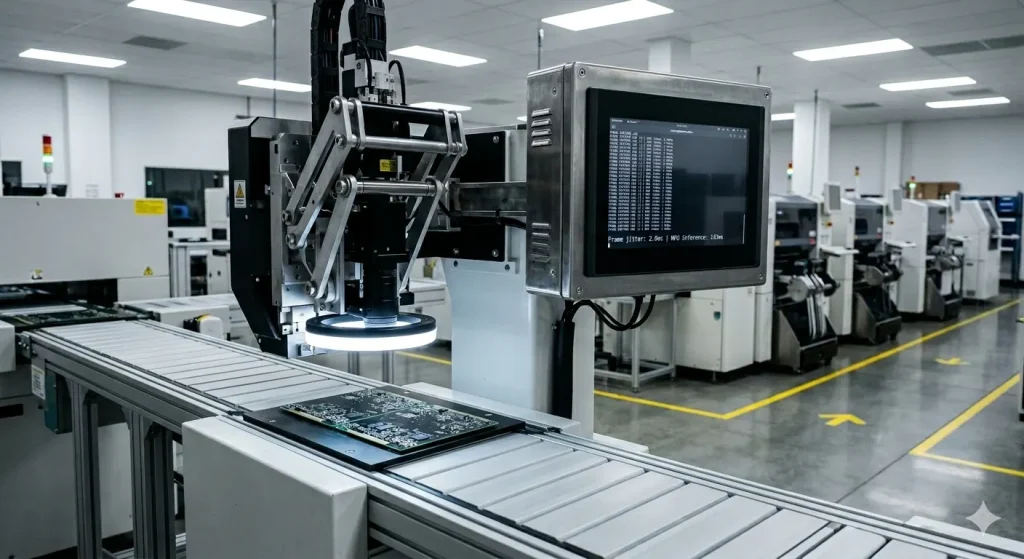
A customer building an automated optical inspection (AOI) system for PCB manufacturing came to us running Android 12 on an early RK3588 prototype. Their reasoning was straightforward: their software team had Android experience, and they wanted a familiar environment.
Six weeks into integration testing, they hit a wall. The vision processing pipeline — capturing frames from a 4K MIPI camera, running defect detection inference on the RK3588 NPU, and flagging anomalies within a 200ms window — was consistently missing the deadline. Android’s process scheduler was introducing unpredictable 40–80ms jitter in the camera frame callback, which cascaded into late inference results and missed conveyor synchronization triggers.
We proposed migrating to a Debian-based Linux image with a customized V4L2 camera driver and a userspace process running at SCHED_FIFO priority for the inference thread. The transition took two engineers eleven days. The result: frame acquisition jitter dropped from 40–80ms to under 3ms, the 200ms end-to-end deadline was met consistently across 72 hours of burn-in testing, and the customer hit their production pilot timeline.
The lesson: Android’s scheduler is optimized for UI responsiveness, not deterministic pipeline throughput. When the product is a machine, not a consumer device, Linux gives you the scheduling control that Android simply doesn’t expose.
Project Case Study: Smart Retail Kiosk Deployment
RK3588 Android deployment, 120-unit rollout, Southeast Asia.
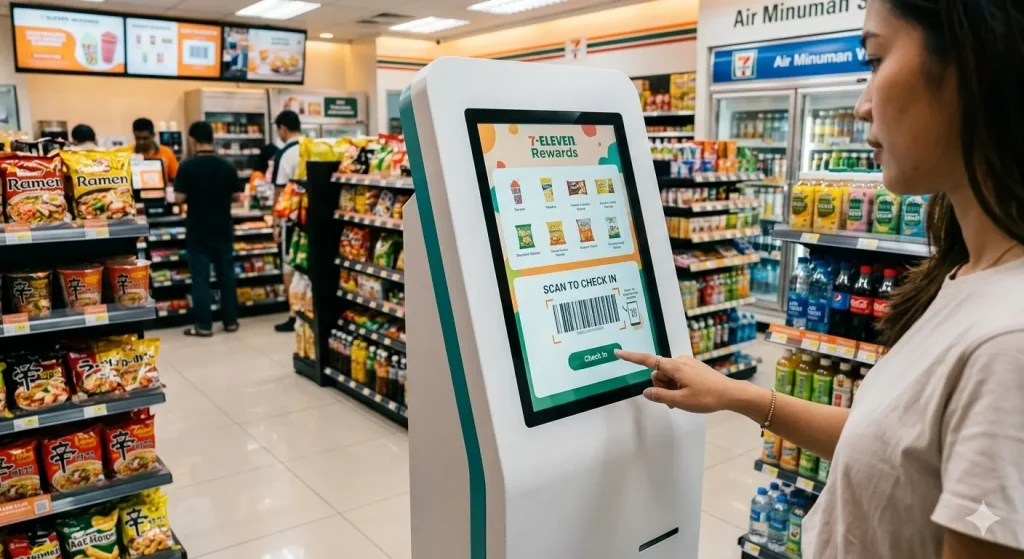
In 2024, a retail technology integrator approached us for an embedded computing platform for a self-service loyalty kiosk to be deployed across 40 convenience store locations in Malaysia and Thailand. Requirements: a 10.1″ capacitive touch display, facial recognition check-in via a USB camera, barcode scanner integration, and offline-capable operation with daily cloud sync.
This was one of the rare cases where Android was the correct choice.
The integrator’s software team had 6 Android developers and zero embedded Linux experience. The product needed to ship in 16 weeks. The UI — a branded, animated rewards interface — was built entirely in Android’s View system and looked polished out of the box.
We supplied RK3588-based boards running Android 12 AOSP with Google Mobile Services removed. NPU-accelerated facial recognition used RKNN-Toolkit2 with a custom MobileNetV3 model, achieving ~98.2% recognition accuracy at under 180ms inference time. The barcode scanner was integrated via Android’s USB HID stack in under a day.
The 120-unit production batch shipped 3 weeks ahead of schedule. In the first 6 months of operation, field failure rate was under 0.8%. The integrator’s Android team was fully self-sufficient for maintenance and OTA updates via a custom MDM solution built on top of AOSP’s device policy APIs.
Key data points:
- Deployment units: 120 across 40 locations
- Facial recognition accuracy: ~98.2%
- Inference latency: <180ms per frame (RK3588 NPU, 6 TOPS)
- Field failure rate (6 months): <0.8%
- Time saved vs Linux UI build: ~6 weeks estimated
The case study confirms the rule: Android on RK3588 is a legitimate industrial choice when the UI is central, the team is mobile-native, and real-time control is not required.
IEEKER YKR-3588S Boards: OS Support and BSP Commitments
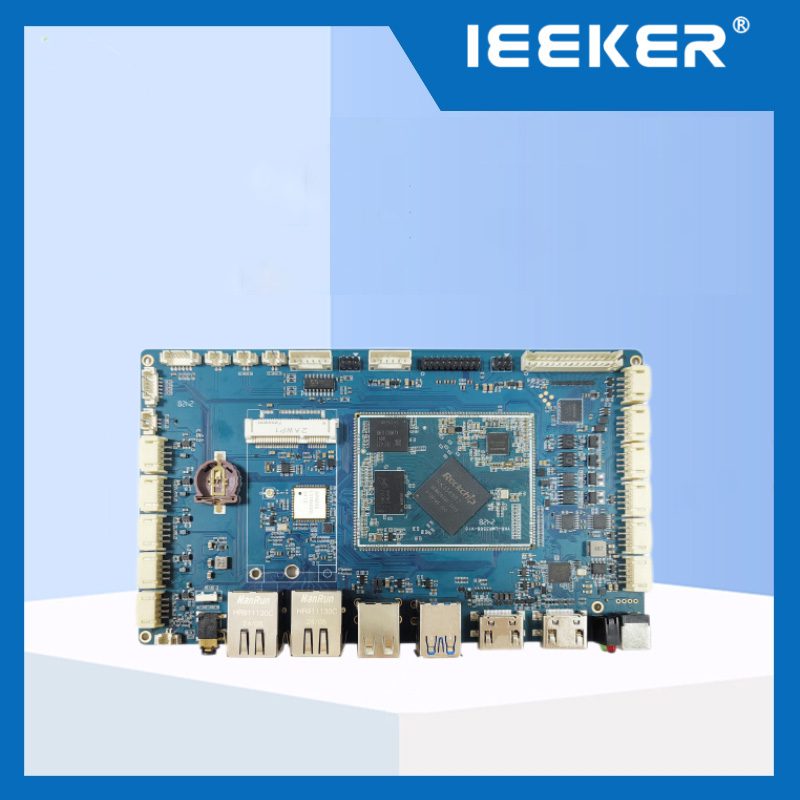
All IEEKER YKR-3588S industrial SBCs ship with multi-OS BSP support: Debian 12, Ubuntu 22.04, Buildroot, and Android 12 AOSP. Each BSP includes:
- Pre-built kernel images and device tree files
- Out-of-box driver support for MIPI CSI, PCIe, USB 3.0, and all onboard peripherals
- RKNN-Toolkit2 integration for NPU inference on both Linux and Android
- 10-year lifecycle commitment with traceable kernel maintenance logs
For custom OS configurations — stripped Buildroot images for mass production, PREEMPT-RT kernel builds for soft real-time applications, or AOSP platform customization — our custom development board design service covers the full OS bringup scope.
If you’re at the OS decision stage and want to discuss your specific use case, contact our engineering team for a no-obligation technical consultation.
FAQ
Can I run both Linux and Android on the same RK3588 board?
Not simultaneously on the same CPU cores, but dual-boot configurations are possible. Some industrial designs use A/B partition schemes to support a Linux recovery environment alongside an Android production image. This adds BSP complexity and is generally only warranted for over-the-air update resilience.
Does the OS choice affect RK3588 NPU performance?
No. RKNN-Toolkit2 delivers equivalent NPU performance on both Linux and Android. The 6 TOPS INT8 figure is a hardware constant, not OS-dependent.
Is Yocto better than Buildroot for RK3588 production?
Yocto offers more flexibility and a larger community recipe ecosystem, but has a steeper learning curve and longer initial build times. For teams without prior Yocto experience, Buildroot reaches production-ready faster. For large organizations maintaining multiple product lines on different SoCs, Yocto’s layer architecture pays off long-term.
What about Windows IoT on RK3588?
Windows on ARM requires Microsoft-approved hardware. RK3588 is not on the approved hardware list for Windows IoT Enterprise, making this a non-viable path for most industrial designs.
Conclusion
The Linux vs Android decision on RK3588 is not a question of which OS is better in the abstract — it’s a question of which OS fits your product’s specific requirements. Linux wins for the majority of industrial applications: headless deployments, edge AI pipelines, real-time-adjacent control systems, and any product with a 5+ year deployment window. Android wins in a specific and well-defined band: rich touch UI applications, kiosk-style products, and teams with mobile development backgrounds.
Use the four-question framework above to make the call early in your design cycle. Switching OS mid-project is not catastrophic, but it costs 2–4 weeks that most industrial schedules don’t have.
For RK3588 boards with pre-validated BSPs across both OS families, explore ieeker’s RK3588 embedded SBC lineup or review our complete embedded Linux board guide for broader platform context.
Sources and References:
- Eclipse Foundation IoT & Embedded Developer Survey 2024
- Linux Embedded Systems Market Size 2026 — commandlinux.com
- Is Android the Right Choice for Embedded Systems in 2025? — MicroEJ
- Choosing IoT OS: Linux vs Windows vs Android — Vantron Tech
- Android Things — Wikipedia
- RKNN-Toolkit2 — Rockchip GitHub
- IEC Industrial Control Systems Standards — iec.ch