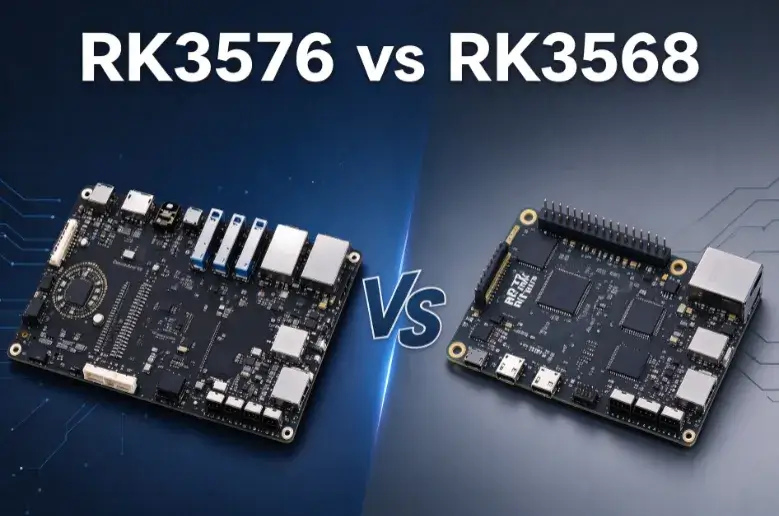
Selecting the correct system‑on‑chip is one of the most critical early decisions for industrial embedded, IoT gateway, HMI and edge vision projects. Wrong chip selection will lead to insufficient performance, wasted budget, or hardware redesign delays in mass‑production. Among Rockchip’s mainstream mid‑range chips, RK3576 and RK3568 are frequently evaluated side‑by‑side by hardware engineers, solution integrators and ODM manufacturers. Many developers also compare them against RK3588, RK3566 and variant models such as RK3568B2, RK3568J and RK3568S during component screening. This guide breaks down hardware specifications, real‑world performance differences, typical application boundaries, cost factors and practical selection advice, supported by a detailed comparison table and FAQ section to support your project decision‑making.
Brief Overview of RK3576 and RK3568
RK3568 is a mature, mass‑proven quad‑core Cortex‑A53 chip built on 22nm process. Since its launch, it has become a workhorse for cost‑sensitive industrial embedded devices. It balances general‑purpose computing, video decoding and rich industrial peripheral interfaces. Multiple derivative versions including RK3568B2, RK3568J and RK3568S have been released for different temperature grade and supply‑chain scenarios. It fits most non‑AI‑heavy industrial control, gateway and display terminal requirements.
RK3576 is Rockchip’s upgraded mid‑range solution. It adopts octa‑core CPU architecture and integrated higher‑performance NPU unit. It keeps good backward compatibility on many peripheral resources while greatly lifting CPU computing capacity, AI inference capability and multi‑channel video processing performance. For projects facing multi‑stream vision analysis, complex edge computing and multitasking workloads, RK3576 provides obvious performance improvement compared with RK3568.
Even though both chips target embedded and industrial scenarios, they orient toward different workload thresholds. Many hardware teams will also do cross‑reference evaluation with RK3588 and RK3566 when drawing up component shortlists. RK3588 delivers flagship‑level performance with higher BOM cost, while RK3566 is positioned at lower‑power lightweight scenarios.
Core Hardware Specification Comparison
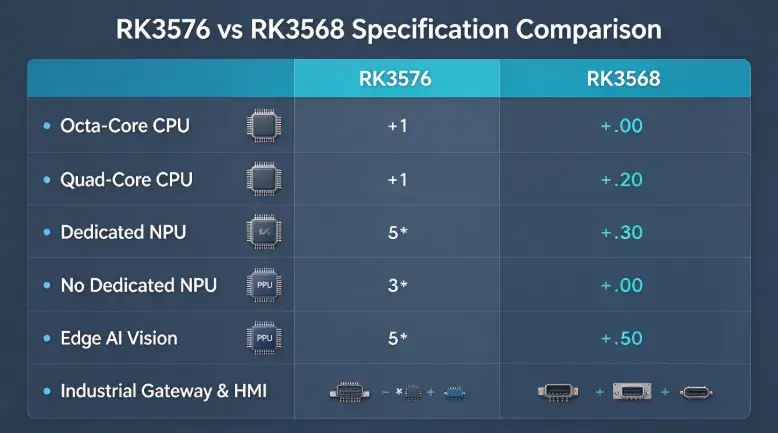
The table below lists key hardware parameters for RK3576, RK3568, and also marks reference information for RK3588 and RK3566 for quick cross‑comparison.
| Parameter | RK3576 | RK3568 | RK3588 | RK3566 |
|---|---|---|---|---|
| CPU | Octa‑core 4×A55 +4×A53 | Quad‑core A53 | Octa‑core A76+A55 | Quad‑core A53 |
| NPU | Up to 6TOPS | No dedicated NPU | 6TOPS | No dedicated NPU |
| GPU | Mali‑G52 | Mali‑G52 | Mali‑G610 | Mali‑G52 |
| Video Decoding | 8K video decode | 4K video decode | 8K decode | 4K decode |
| Ethernet | Dual Gigabit Ethernet | Dual Gigabit Ethernet | Dual Gigabit Ethernet | Single Gigabit Ethernet |
| Typical Use | Edge AI, multi‑channel vision, heavy multitasking | Industrial gateway, HMI, light‑load IoT | High‑end AI box, high‑performance industrial terminal | Low‑cost lightweight embedded device |
| Derivative Variants | Standard version | RK3568B2, RK3568J, RK3568S | Standard industrial version | Cost‑optimized variants |
From hardware indicators, the most prominent gap lies in CPU core count and dedicated NPU. RK3568 can only implement very light AI algorithm inference relying purely on CPU and GPU computing resources. If you run multiple model recognitions simultaneously, frame rate will drop significantly and system load will surge. RK3576 with built‑in NPU can handle multi‑channel object detection, image recognition and edge analysis tasks stably. Both chips support dual Gigabit Ethernet, which is very valuable for industrial gateway products.
Practical Performance Differences in Real‑World Projects
Paper specifications cannot fully reflect actual deployment performance. Many engineers encounter performance bottlenecks only after prototype testing.
For light‑load projects: such as simple HMI display, serial‑port data collection, single‑channel video playback, basic protocol conversion gateway. Under these conditions, RK3568 works perfectly. Its mature software ecosystem, abundant community resources and stable component supply make it a safe choice. Variants like RK3568B2, RK3568J and RK3568S provide different temperature resistance and screening levels for industrial‑grade needs.
For medium‑to‑heavy‑load scenarios: running multiple background services, multi‑camera input, local AI analysis, multi‑stream video decoding. In these cases RK3568 will reach resource bottleneck easily. CPU occupancy keeps high, interface response slows down, and video frame dropping occurs. At this point RK3576 octa‑core CPU plus dedicated NPU can resolve the pressure.
If your project pursues higher‑level AI computing and 8K display output, teams will further evaluate RK3588. But it brings higher power consumption and total material cost. If the project budget is tight and the task load is low, RK3566 can be considered as a further cost‑reduction option.
Typical Application Scenarios
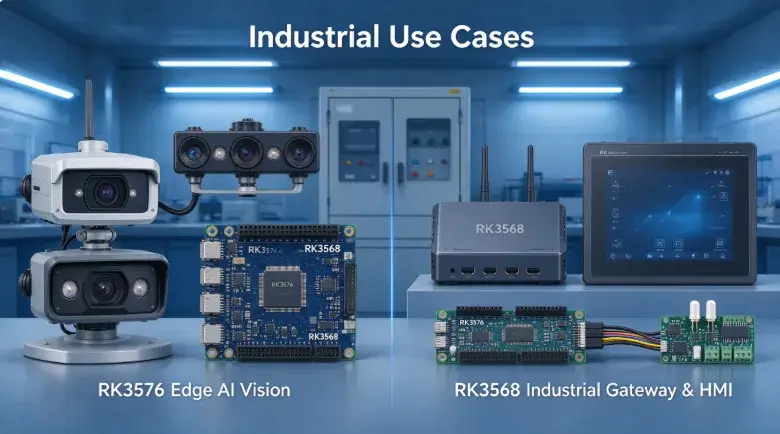
Projects suitable for RK3568
- Industrial HMI man‑machine interaction terminals without local AI functions
- Dual‑port Gigabit industrial IoT gateway for data acquisition and protocol conversion
- Digital signage, simple display control equipment
- Light‑duty embedded control equipment that requires long‑term stable supply
- Cost‑sensitive mass‑production projects with low computing requirements
RK3568 series including RK3568B2, RK3568J, RK3568S covers commercial to wide‑temperature industrial grades. You can select corresponding component versions according to equipment working environment.
Projects suitable for RK3576
- Edge vision equipment requiring local AI image analysis
- Multi‑camera access edge computing box
- Complex industrial gateway running multiple software services at the same time
- Devices that need both multi‑channel video decoding and local algorithm processing
- New‑generation embedded products which reserve performance margin for later function iteration
Key Points for Chip Selection and Cost Evaluation
When comparing RK3576 vs RK3568, hardware teams should not only compare chip unit price. You need to evaluate total project cost and long‑term risk.
First, confirm real workload. Do not overspec hardware. Many projects adopt RK3576 blindly, but in fact the business logic can be fully satisfied by RK3568, resulting in unnecessary BOM increase. Conversely, choosing RK3568 for AI vision projects will cause repeated modification of hardware and firmware.
Second, clarify component grade. Distinguish commercial version and industrial wide‑temperature version. Pay attention to different specifications among RK3568B2, RK3568J, RK3568S. Different suffix versions differ in operating temperature range and screening standard.
Third, verify BSP and SDK support status. Even with powerful chip hardware performance, incomplete BSP support will increase software development cycle. Confirm vendor’s Linux, Android SDK update and technical support before sample purchase.
Fourth, consider long‑term supply cycle. Industrial equipment usually requires 5‑10‑year component supply guarantee. Confirm supplier’s supply plan for the selected chip before formal project confirmation.
Frequently Asked Questions
Q1 What is the core difference between RK3576 and RK3568
A: RK3576 uses octa‑core CPU and integrates dedicated NPU for AI computing. RK3568 is quad‑core CPU without independent NPU. RK3568 fits light‑load industrial control and gateway. RK3576 is oriented to projects with AI vision and heavy multitasking demands.
Q2 What are the differences among RK3568B2, RK3568J, RK3568S
A: They are different screening variants of RK3568 chip. Main differences lie in operating temperature range and component screening standard. B2 is commercial grade, J is industrial wide‑temperature grade, S is special‑screening version. Select according to your equipment working environment.
Q3 Should I choose RK3576 or upgrade directly to RK3588
A: If your main requirement is multi‑channel AI inference and you do not need flagship 8K high‑spec display performance, RK3576 can balance performance and cost. If you need ultra‑high‑performance computing and rich high‑speed interfaces, evaluate RK3588.
Q4 Can RK3568 run AI algorithms
A: RK3568 has no dedicated NPU. It can run only very lightweight AI reasoning through CPU and GPU. Multi‑channel and complex AI tasks will face serious performance bottlenecks. Such projects suggest choosing RK3576.
Q5 When is RK3566 a better alternative
A: RK3566 suits low‑cost, low‑power consumption lightweight embedded projects. It only has single Gigabit Ethernet, so it is not suitable for dual‑Ethernet gateway scenarios.
Conclusion
RK3576 and RK3568 are both high‑quality mid‑range chips in Rockchip product portfolio, but they serve different project positioning. RK3568 and its derivative models RK3568B2, RK3568J, RK3568S rely on mature ecology and stable supply chain, becoming cost‑effective solution for mass‑produced light‑load industrial equipment. RK3576 makes breakthroughs in multi‑core computing and AI inference capability, solving performance pain points of edge vision and heavy multitasking embedded devices.
Before finalizing hardware design, confirm actual business workload, operating temperature environment, software SDK support and long‑term component supply. Conduct sufficient prototype testing, avoid only judging from chip datasheet parameters. When necessary, cross‑compare RK3588 and RK3566, to lock the most suitable chip solution for your embedded product.