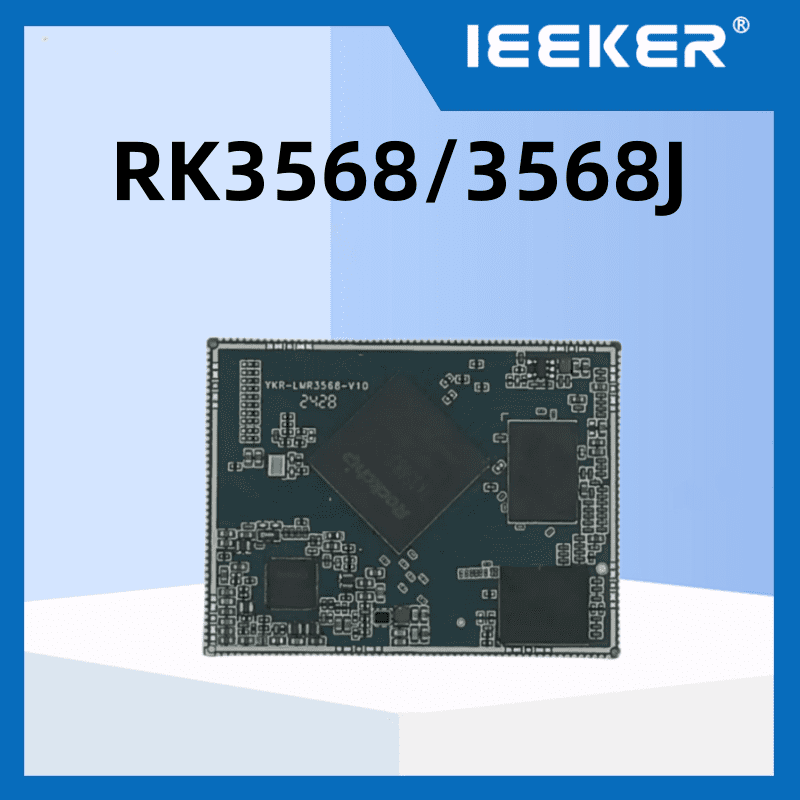
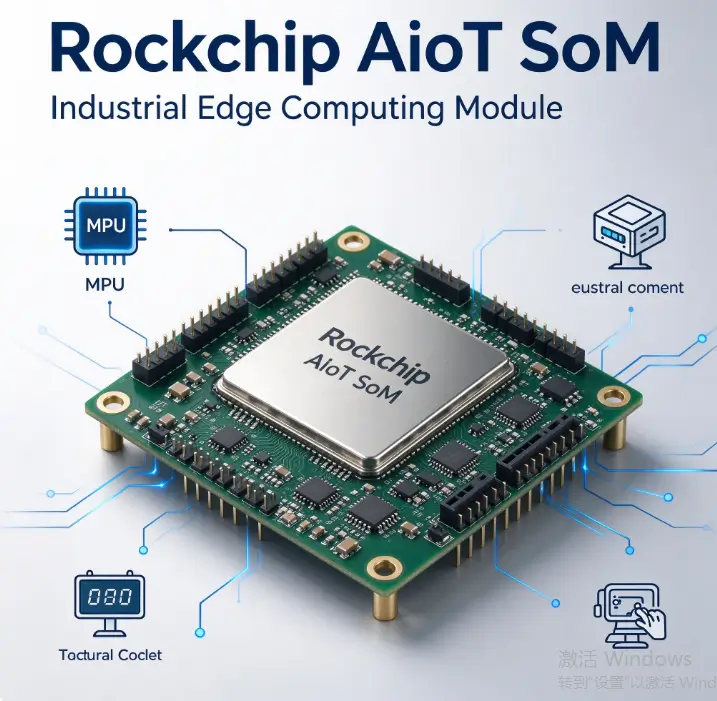
AIoT SoM (AI of Things System-on-Module) is a compact, ready-to-deploy computing module that integrates a processor, memory, storage, and core power management on a single PCB, designed to be mounted on a carrier board for industrial and edge-AI products. It is the fastest and most reliable way to move from idea to a deployable AI device, because it moves the most difficult engineering — silicon bring-up, memory layout, power sequencing, and operating-system porting — off your critical path.
This guide explains what an AIoT system-on-module is, how it differs from a single-board computer, and the concrete selection criteria that decide whether your project ships on time or stalls in the lab. Where possible, we reference the Rockchip RK3588, RK3588S, and RK3568 platforms that we design and manufacture at IEEKER, so the specifications you see here are ones we actually build, test, and ship in production.
AIoT SoM vs SBC: What Is the Real Difference?
The most common point of confusion is the boundary between an AIoT SoM and an SBC (single-board computer). Both are built on the same Rockchip processors, and both can run Android and Linux. The difference is architectural:
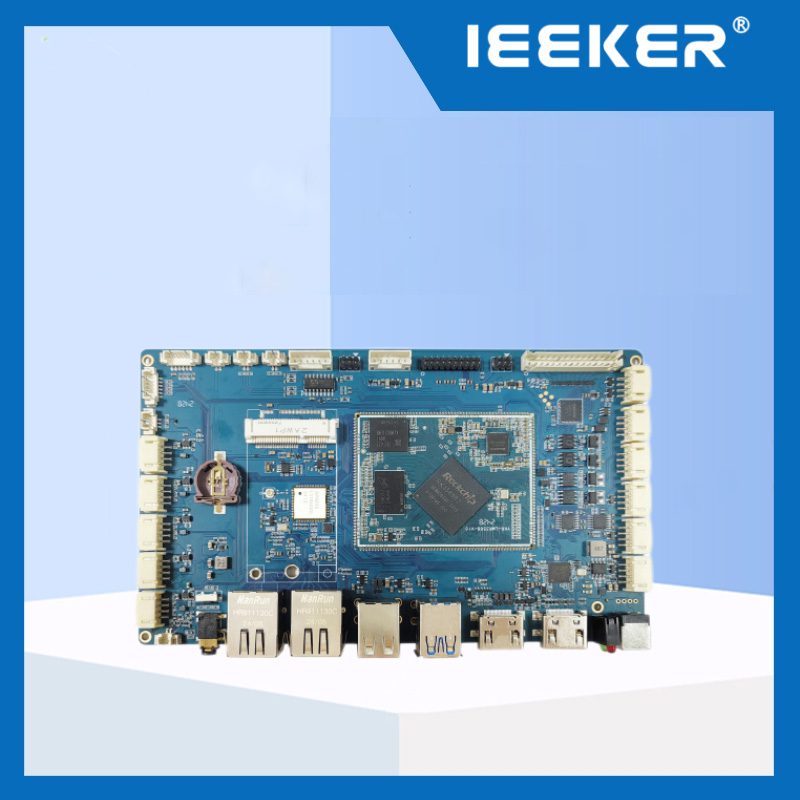
- An AIoT SoM exposes compute on edge connectors (DDR SODIMM-style or board-to-board) and requires a custom carrier board. You design the carrier once and reuse the module across many products.
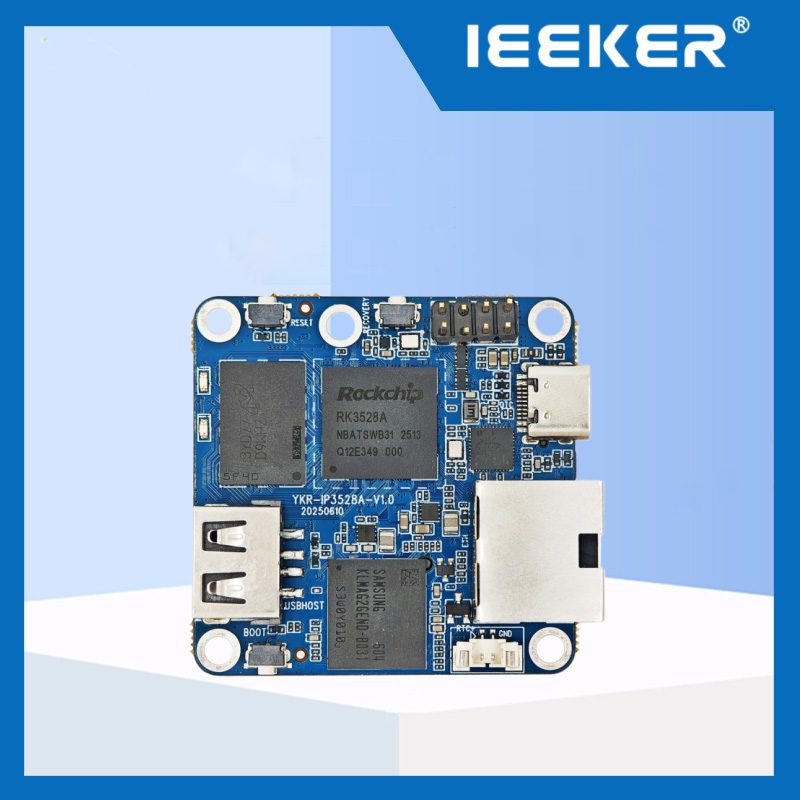
- An SBC integrates the compute, I/O, connectors, and often the enclosure layout onto one fixed board. It is ideal for prototyping, low-volume deployments,s and off-the-shelf applications where you do not control the form factor.
For a manufacturer building a product line — for example, an industrial HMI, a gateway, a digital signage player or a machine-vision camera — the AIosystem-on-module approach usually wins. You invest once in carrier design, then iterate by swapping modules when the next Rockchip processor generation ships. In contrast, an SBC locks you into a fixed layout that is expensive to re-engineer when your requirements change.
Why Choose an AIoT SoM Instead of Building from Scratch
A custom board built from discrete components gives you total control, but it also hands you the riskiest parts of embedded engineering. A module transfers that risk to a vendor that has already solved the hard problems. In practice, engineers and procurement teams choose an industrial AIoT SoM for four reasons:
1. Shorter Time to Market
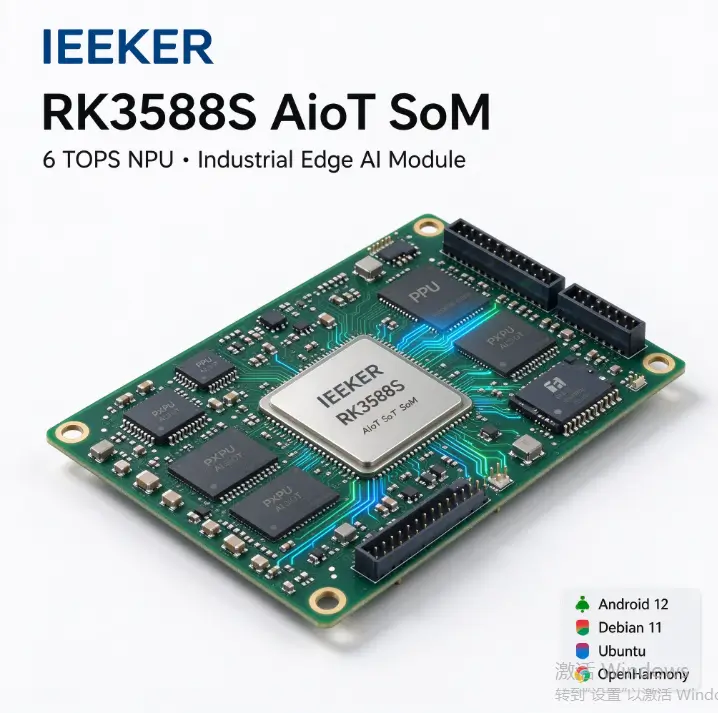
Bringing up a new processor, validating memory, tuning power rails, and porting U-Boot and the kernel can take several engineering-months. A qualified module arrives with boot firmware, device tree, and an Android or Linux BSP already working. At IEEKER, modules such as our RK3588S-based boards ship with Android 12, Debian 11, Ubuntu 20.04/22.04 and OpenHarmony 4.1 images, so your team starts application development instead of board bring-up.
2. Reduced Engineering and Risk
Memory routing on high-speed Rockchip platforms is sensitive. When it is done wrong, the board is unreliable,e and the fault is buried in layout, not software. A module vendor owns that layout problem and has already validated signal integrity, thermal behavior, and EMI in real production.
3. Reuse Across a Product Family
With an AIoT SoM, one compute module can power several products — an HMI, a gateway,y and a signage player — by changing only the carrier. This is why ODM customers typically standardize on a module family instead of a single board.
4. Long-Term Supply and Scalability
An AIoT SoM with a documented lifecycle protects you from processor obsolescence. Because the module interface is stable, you can migrate to a newer Rockchip SoC without redesigning the carrier, keeping your product on the market for years.
How to Choose the Right AIoT SoM: 7 Selection Criteria That Matter
Not every “AIoT SoM” is appropriate for industrial deployment. Here is the checklist our engineers apply when a customer asks us to recommend a Rockchip system-on-module.
1. Compute and NPU Performance
Match the module to the workload, not the other way around. For edge-AI inference and multi-camera vision, you need a dedicated NPU. The RK3588 and RK3588S integrate an NPU delivering up to 6 TOPS of mixed INT4/INT8/INT16/FP16 performance — enough for real-time object detection, defect classification, and OCR at the edge without a GPU. The RK3568, with its 1 TOPS NPU, is a better fit for HMI, IoT gateways,s and NVR workloads where cost and low power matter more than raw inference throughput.
2. CPU and GPU Architecture
For compute-heavy tasks, look at the CPU cluster. The RK3588S pairs four Cortex-A76 cores at up to 2.4 GHz with four Cortex-A55 cores at 1.8 GHz on an 8nm process, alongside a Mali-G610 MP4 GPU with OpenGL ES 3.2, Vulkan 1,.2 and OpenCL 2.2 support. This combination handles both heavy single-thread work and efficient background tasks in the same package.
3. Memory and Storage Flexibility
Industrial deployments often run for years, so choose headroom. On our RK3588S boards, memory ranges from 1 GB to 8 GB LPDDR4/LPDDR4X, with eMMC storage options from 8 GB up to 256 GB, plus a microSD slot for expansion. Higher memory matters for AI models that cache in RAM rather than streaming from storage.
4. Connectivity and Interfaces
Count the interfaces you actually need. USB 3.0 for high-speed peripherals, Gigabit Ethernet for networking, HDMI 2.1 and MIPI DSI for display, and MIPI CSI for cameras. The RK3588S supports 8K display output and hardware-based 48 MP ISP with dual-ISP (48M + 16M), which matters if your product captures or drives high-resolution content.
5. Operating-System and BSP Support
The quality of the BSP determines your software cost. A vendor that supports Android, Linux, Debian, and OpenHarmony gives you options and reduces lock-in. Confirm that the vendor provides updated kernel and firmware images, not just a one-time release.
6. Operating Temperature and Environment
For outdoor, kiosk, and cabinet deployments, verify the module’s operating range. Industrial modules are typically qualified for a wider temperature range than consumer boards. Ask for documented environmental testing rather than assuming a spec from the datasheet.
7. Supply, Customization and Vendor Reliability
Because an AIoT SoM becomes the heart of your product, the vendor’s ability to support volume, customization,n and long-term supply is as important as the silicon. At IEEKER, we run an in-house manufacturing line, which means we control production, can deliver customized hardware and firmware, and can support OEM/ODM requirements from prototype to mass production. Our R&D team has over 18 years of embedded experience across ARM-based architecture, PCBA development,nt and Android/Linux deep customization.
Real-World AIoT SoM Applications
An AI system-on-module with the right balance of NPU, I/O, and power scales across many verticals. The three most common deployments we see in production are:
Digital Signage and Kiosk
An AIoT SoM powers interactive displays with 8K output, touch input, and remote management. The 6 TOPS NPU enables on-device audience analytics and content personalization without sending data to the cloud.
Industrial IoT Gateways
A gateway aggregates sensors, controllers,s and legacy equipment over Ethernet, serial, and fieldbus. It needs reliable Linux, low power,r and a long lifecycle. The RK3568’s 1 TOPS NPU and modest power profile make it a strong, cost-effective gateway candidate.
Machine Vision and Edge AI
For defect detection, OCR, and counting at the edge, the RK3588/RK3588S family runs models such as YOLOv5s at real-time frame rates on-device. Inference happens locally, which keeps latency low, cuts bandwidth costs,s and preserves data privacy on the factory floor.
Our Engineering Perspective on AIoT SoM Selection
From 18 years of building and shipping embedded boards, the single biggest mistake we see is teams choosing compute first and treating power, thermal, ls and OS support as afterthoughts. A module that runs a demo well in the lab can fail in a sealed industrial cabinet at 50 °C.
Our advice: define the deployment environment before the bill of materials. First, if the product lives outdoors, verify the module’s thermal and ingress behavior. Next, if it runs unattended, confirm boot reliability and the availability of OTA or remote management. Finally, if the product will ship for five years, confirm the module’s supply commitment and the vendor’s ability to support your volume. These decisions are what separate a one-off prototype from a product that ships.
AIoT SoM vs SBC: Which Should Your Team Choose?
Use this simple rule to decide:
- Choose an AIoT SoM when you will build multiple products, need a custom form factor, want to reuse compute across generations, or require a carrier design you control.
- Choose an SBC when you need the fastest path to a working device, plan low-volume deployment, or want an off-the-shelf, enclosure-ready platform.
For most industrial ODM projects, the AIoT SoM path is the higher-leverage investment, even though it adds an upfront carrier-design cost.
FAQ
What does AIoT SoM mean?
AIoT SoM stands for “AI of Things System-on-Module” — a compact computing module that integrates a processor, memory, storage, and power management on a single board and connects to a custom carrier via edge connectors. It adds an AI/NPU capability to IoT devices.
What is the difference between an AIoT SoM and an SBC?
An AIoT SoM is a compute module that requires a custom carrier board and is designed for reuse across multiple products. An SBC is a complete, standalone board with fixed I/O and connectors, ideal for prototyping and off-the-shelf deployments.
Why choose a Rockchip AIoT SoM for industrial IoT?
Rockchip platforms such as the RK3588, RK3588S and RK3568 deliver strong NPU performance, broad OS support (Android, Linux, Debian, OpenHarmony) and a mature BSP ecosystem at a competitive cost, making them well suited to industrial gateways, signage, kiosks and edge-AI products.
How much AI performance does an AIoT SoM with NPU need?
It depends on the workload. A 6 TOPS NPU (RK3588/RK3588S) handles real-time object detection and defect classification at the edge, while a 1 TOPS NPU (RK3568) is sufficient for HMHMI gateways and NVR tasks. Choose based on your actual inference workload, not the largest number.
Can an AIoT SoM be customized?
Yes. Vendors with in-house manufacturing, such as IEEKER, can customize memory, storage, interfaces, firmware, and BSP to match a customer’s requirements, supporting OEM/ODM from prototype to mass production.
Get Started with a Rockchip AIoT SoM
The right AIoT SoM removes the hardest engineering risk from your project and puts your team on the path to a shippable product. Whether you are building an HMI, an industrial gateway, a signage player, or a machine-vision camera, we can help you select and customize a Rockchip RK3588, RK3588S, or RK3568-based module for your application.