When designing cost-effective embedded devices, industrial HMIs, smart displays, and lightweight edge AI products, hardware engineers constantly look for stable, well-supported mid-range SoCs. Among Rockchip’s latest generation of embedded processors, the Rockchip RK3576 stands out as a highly balanced octa-core solution that delivers solid CPU performance, optimized power efficiency, complete multimedia capabilities, and mature software ecosystem support. It has quickly become one of the most popular chips for mass-production embedded projects due to its balanced BOM cost, low heat generation, and rich peripheral expansion. This article provides a complete engineer-oriented overview of the Rockchip RK3576, including detailed specifications, official datasheet and TRM resources, SDK development environment, professional hardware design guidelines, typical application scenarios, and a detailed comparison between Rockchip RK3576 and Unisoc T820.
Key Hardware Specifications of Rockchip RK3576
The Rockchip RK3576 is built on a mature and power-efficient semiconductor process, featuring an 8-core CPU architecture designed to balance multi-tasking performance and low-power consumption. Unlike high-end SoCs that pursue extreme performance or entry-level chips with limited computing capability, the RK3576 is precisely positioned for mid-tier embedded scenarios that require stable continuous operation, long-term reliability, and controllable costs.
8-Core Heterogeneous CPU Architecture
The octa-core CPU cluster of Rockchip RK3576 adopts a big.LITTLE heterogeneous design, which dynamically adjusts operating frequency and core activation according to system load. When running UI rendering, multi-threaded data processing, or multimedia decoding tasks, high-performance cores are activated to ensure smooth system response. For standby, background monitoring, and low-duty-cycle IoT tasks, the system automatically switches to power-saving cores to reduce overall power consumption and heat generation. This flexible scheduling mechanism makes the RK3576 extremely suitable for 24/7 uninterrupted industrial embedded equipment, smart display terminals, and edge gateway devices.
Integrated Multimedia and Display Performance
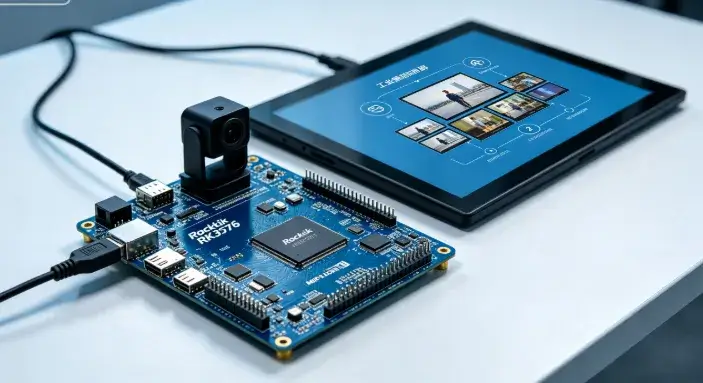
One of the core advantages of the Rockchip RK3576 is its powerful integrated multimedia engine. It supports high-resolution video decoding, multi-channel video input, and multi-screen asynchronous display output. The chip is compatible with mainstream industrial display interfaces including HDMI, MIPI, and LVDS, covering almost all common sizes of industrial touch screens, commercial displays, and smart terminal screens. For product developers, the rich native display interfaces greatly simplify secondary circuit design, reduce peripheral chip costs, and shorten the product development cycle.
Rich Industrial Peripheral Interfaces
Rockchip RK3576 reserves complete industrial-grade peripheral resources, including Ethernet, USB, UART, I2C, SPI, and PWM interfaces. These interfaces fully meet the expansion requirements of industrial data collection, sensor access, serial port communication, and network transmission. Whether used for industrial control hosts, IoT edge gateways, or smart retail terminals, the RK3576 can easily meet the hardware expansion needs of diverse embedded scenarios.
Rockchip RK3576 Datasheet and TRM Reference Materials
For professional hardware design and driver development, the RK3576 datasheet and Technical Reference Manual (TRM) are the most authoritative technical documents. They are essential resources for schematic design, PCB layout, electrical parameter confirmation, and underlying driver adaptation.
Official RK3576 Datasheet Overview
The Rockchip RK3576 datasheet comprehensively records the chip’s core parameters, including working voltage range, maximum operating frequency, power consumption parameters, temperature tolerance range, pin definition functions, and electrical characteristic indicators. Hardware engineers must strictly follow datasheet specifications during power domain design, DDR matching, and signal routing to avoid unstable operation, compatibility failures, or hardware damage caused by out-of-spec operation. It is worth noting that official Rockchip datasheets are mainly provided to authorized customers and cooperative ODM manufacturers for commercial product development, and complete public downloads are not available on open search platforms.
RK3576 TRM for In-Depth Driver Development
Compared with the datasheet, the RK3576 TRM provides more underlying technical details, including register address mapping, interrupt control logic, NPU operation principles, multimedia engine workflow, and clock tree configuration rules. Kernel developers and embedded driver engineers rely on the TRM to complete system kernel tailoring, driver porting, and function secondary development, which is the core document for realizing customized firmware development based on RK3576.
Rockchip RK3576 SDK and Software Ecosystem
A complete and stable software ecosystem is the key reason why Rockchip RK3576 is widely adopted in mass production projects. Rockchip officially provides complete RK3576 SDK packages, covering mainstream operating systems and mature underlying driver frameworks, allowing development teams to quickly implement product functions without repeated underlying development.
Supported OS and SDK Core Components
The RK3576 official SDK supports Android and Linux dual system solutions, including complete U-Boot boot program, device tree configuration files, Linux kernel source code, multimedia decoding and encoding drivers, camera V4L2 drivers, display screen adaptation drivers, and RKNN NPU inference runtime. Developers can directly compile and deploy the SDK to complete basic system startup, screen display, video processing, and lightweight AI reasoning functions. For industrial projects that require high stability, the Linux SDK provides a more concise and reliable operating environment; for smart display and consumer terminal projects, the Android SDK supports richer application expansion and human-computer interaction functions.
RK3576 SDK Development Advantages
The RK3576 SDK adopts Rockchip’s unified software architecture, which is highly compatible with the development habits of RK3568 and RK3588 platforms. Engineers familiar with traditional Rockchip embedded development can quickly get started with RK3576 project migration and secondary development, greatly reducing the learning cost and project trial cycle. In addition, the official continuously iterates SDK versions, fixes system bugs, optimizes power consumption strategies, and improves system stability for long-term industrial operation scenarios.
Rockchip RK3576 Hardware Design Guide
Even with excellent chip performance and complete SDK support, unreasonable hardware design will still lead to unstable equipment operation, poor heat dissipation, signal interference, and mass production risks. The official Rockchip RK3576 hardware design guide standardizes the entire process from schematic design to PCB layout, providing crucial guidance for industrial mass production products.
Key design specifications include power supply sequence control, DDR wiring length matching, impedance design standards, power integrity optimization, thermal pad layout, and ESD anti-interference protection. Many unstable problems of RK3576 core boards in actual use, such as screen flickering, occasional restart, network drop, and high-temperature frequency reduction, are caused by non-standard layout and power design. Strictly following the official design guide can effectively improve product stability and yield rate of mass production.
Rockchip RK3576 Price and Commercial Sourcing Status
The Rockchip RK3576 price is very competitive in the mid-range embedded SoC market. Compared with high-performance chips such as RK3588, the RK3576 has lower BOM cost and lower heat dissipation requirements, making it more suitable for cost-sensitive large-scale mass-production projects. The specific unit price is affected by order quantity, purchasing method (bare chip or core board), supply cycle, and customized service requirements. Small-batch sample orders have a higher unit price, while long-term large-volume OEM orders can obtain more favorable pricing support.
In actual project budgeting, developers should not only consider the chip price but also comprehensively evaluate the overall cost of PCB assembly, peripheral matching, software development, and product certification. The RK3576’s mature ecosystem can greatly save subsequent development and maintenance costs, bringing higher comprehensive cost performance for embedded projects.
Rockchip RK3576 vs Unisoc T820 Best Options for Embedded Projects
In mid-range embedded and smart display markets, Rockchip RK3576 vs Unisoc T820 is one of the most common chip selection comparisons. Both chips target cost-effective intelligent terminal scenarios, but there are obvious differences in ecosystem positioning, industrial adaptability, and software support.
Rockchip RK3576 focuses more on industrial embedded and edge computing scenarios, with richer industrial peripheral support, more stable long-term operation capability, and complete open-source SDK and community resources. It is more suitable for industrial control, HMI, edge gateway, and industrial vision equipment. Unisoc T820 is more inclined to consumer-grade smart displays and intelligent terminal products, with advantages in multimedia optimization and mobile scenario adaptation. For teams that have long-term Rockchip platform development experience, the RK3576 has lower technical risks and faster project landing speed.
Common Application Scenarios of Rockchip RK3576
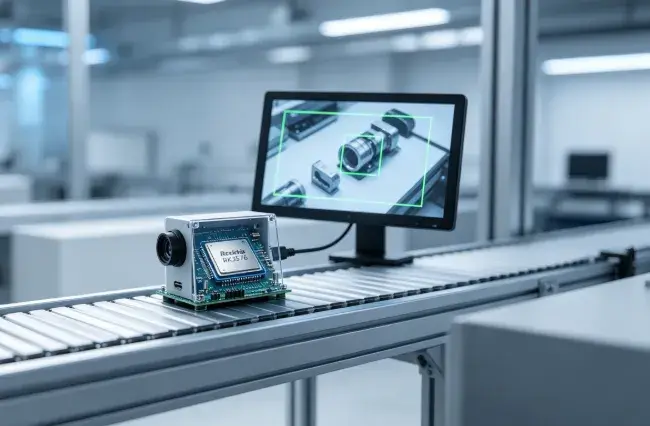
Thanks to its balanced performance, low power consumption, rich interfaces, and mature software ecology, Rockchip RK3576 is widely used in various embedded intelligent terminal scenarios:
- Industrial HMI touch panels and factory automation control terminals
- Commercial smart displays, digital signage, and retail intelligent screens
- Lightweight edge AI identification and industrial defect detection equipment
- IoT edge gateways, data acquisition terminals, and smart monitoring devices
- Smart home control hosts and vehicle auxiliary display terminals
Final Thoughts
The Rockchip RK3576 is a cost-effective, stable, and mature mid-range embedded SoC, perfectly balancing performance, power consumption, and development difficulty. For engineers and product teams who need to develop embedded devices, smart displays, and lightweight edge AI products, mastering RK3576 specs, understanding official datasheet and TRM documents, being familiar with SDK development processes, and following standardized hardware design rules can greatly improve project stability and mass production yield. When selecting chips, you can complete horizontal evaluation through Rockchip RK3576 vs Unisoc T820 comparison to select the most suitable solution for your project positioning.