
Short answer: Embedded board certification is more nuanced than most buyers realise. A CE or FCC mark on a development board covers the board as a component — not necessarily your finished product. To legally sell your device in the EU or US, you may need system-level certification, not just a certified board. This guide explains what each certification covers. It tells you which documents to request from your supplier. It also covers what changes to a board design trigger re-certification. That way your product won't fail an import check after it ships.
Certification questions come up at two points in an embedded project. The first is during supplier evaluation: "Does your board have CE and FCC?" The second comes weeks before shipment. It goes: "Does our embedded board certification cover our end product?" Getting the answer wrong at that point is expensive. This guide addresses both.
We cover the four certifications that come up in almost every B2B embedded board procurement: CE, FCC Part 15, RoHS, and ISO 9001. We then address certifications for specific industries. These include IEC 60601-1 for medical devices, IEC 61508 for functional safety, and ATEX for hazardous environments.
Key Takeaways
- A board-level CE or FCC certification covers the board as a sub-assembly — your finished product may need its own system-level certification
- FCC Part 15B (unintentional radiator) applies to any digital board; FCC Part 15C/247 applies if the board has Wi-Fi, Bluetooth, or other intentional RF
- CE marking requires a Declaration of Conformity against specific directives — always ask which directives (EMC, LVD, RoHS, RED) the certificate covers
- RoHS compliance is a material-level check — it must extend through the entire supply chain, including connectors, cables, and solder
- ISO 9001 certification covers the manufacturer's quality management system, not the product itself
- Hardware changes — even replacing a DRAM vendor — may invalidate existing FCC or CE test reports
- For medical, functional safety, or hazardous environment applications, board-level certifications are insufficient; specialised system-level testing is required
- Always request the full test report, not just the certificate — the test report reveals which specific board revision was tested
Board-Level vs System-Level Certification: The Critical Distinction
This is the most important concept in embedded board certification, and the most commonly misunderstood. When a development board carries a CE or FCC mark, it means that specific board met the regulatory requirements. This applies only in its tested configuration — with its original components and the software used during testing. It does not mean your finished product automatically inherits that certification.
Your finished product is a system. It includes the board, your custom carrier board or enclosure, any additional peripherals, your application firmware, and your power supply. Regulators assess the product your customer buys, not the components inside it. If your product is a medical monitor, an industrial gateway, or a digital kiosk, the complete device must pass testing. Not just the compute board inside.
There is a practical middle ground. FCC's "modular" or "limited modular" approval allows a certified radio module inside your product to count toward your FCC compliance, within defined conditions. CE similarly allows sub-assembly certifications to contribute to a system Declaration of Conformity. But these have specific conditions. A board-level EMC test in an open-frame configuration may not represent your product's actual emissions when installed in a metal enclosure with cables attached. EMC test results are highly sensitive to physical configuration.
Ask your board vendor one practical question. "Does your CE test report cover the board as a finished product, or as a sub-assembly?" The answer determines how much additional testing your product needs.
CE Marking: Embedded Board Certification for the European Market
CE marking is mandatory for products sold in the European Union and European Economic Area. It is not a single standard — it is a declaration that the product meets the requirements of one or more EU directives. For an embedded board, the relevant directives are typically:
- EMC Directive (2014/30/EU): Electromagnetic compatibility. The board must not emit excessive electromagnetic interference, and must function correctly in the presence of external interference. This is tested for radiated and conducted emissions and immunity.
- Low Voltage Directive (2014/35/EU): Electrical safety for products operating between 50V AC and 1000V AC (or 75V DC to 1500V DC). Many development boards operate at 5V or 12V DC, placing them outside the strict scope of LVD — but some industrial boards with higher-voltage power inputs may fall within it.
- RoHS Directive (2011/65/EU, amended 2015/863/EU): Restriction of hazardous substances. This is typically included in CE declarations for electronic products. See the RoHS section below for details.
- Radio Equipment Directive (2014/53/EU, or RED): Mandatory if the board includes radio transmitters — Wi-Fi, Bluetooth, Zigbee, cellular, or other intentional RF. RED replaces the old R&TTE directive and is stricter about cybersecurity requirements.
When requesting CE documentation, always ask for the full Declaration of Conformity (DoC). The DoC must list the specific directives and harmonised standards the product was tested against. A CE logo alone tells you nothing. Ask also for the underlying test report — this identifies the exact board revision tested, the test laboratory, and the test dates. As the embedded board certification guide from Promwad notes: planning for CE requirements from the design phase saves time, cost, and frustration. Companies that approach certification after design is finalised routinely face expensive redesigns to address EMC failures.
One practical check: the EU operates a NANDO database (New Approach Notified and Designated Organisations) for Notified Bodies. Verify the test lab in the NANDO database. If the lab is not listed for the relevant directive, the certificate may not be valid for EU market access. Verify the test lab before relying on any CE documentation.
FCC Part 15: What It Covers and How to Verify It
The FCC Part 15 rules govern unintentional radiators — any digital device that generates radio frequency energy as a byproduct of its operation. This includes virtually every development board with a processor. FCC Part 15 splits into two categories for embedded board certification:
- Part 15B — Unintentional Radiators: Covers the board's incidental RF emissions. Any board with a processor running above 9 kHz must comply. The manufacturer can self-certify via a Supplier's Declaration of Conformity (SDoC) for Class B devices (consumer) or file a technical report for Class A (commercial/industrial). No FCC ID is required for unintentional radiators certified via SDoC.
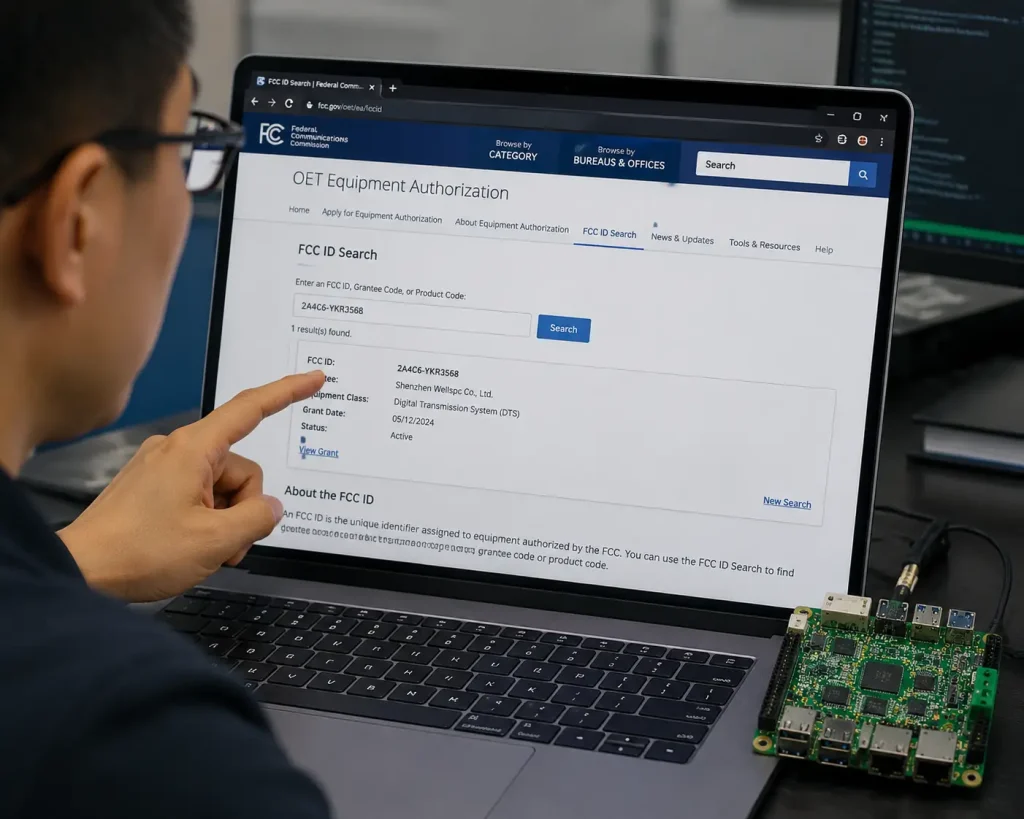
- Part 15C and 47 CFR Part 247 — Intentional Radiators: Covers devices that intentionally transmit RF — Wi-Fi, Bluetooth, Zigbee, cellular. These require FCC ID certification from an accredited Telecommunications Certification Body (TCB). The FCC ID is publicly searchable on the FCC website. Always verify the FCC ID in the public database if the board includes wireless.
The FCC certification process for intentional radiators takes four months on average. Costs for connected devices run approximately $3,000 to $5,000. Modules (Wi-Fi, BT, cellular) cost $5,000 and above. These timelines and costs are relevant if your product design adds radio capability to a base board that wasn't originally tested with it.
A key FCC compliance rule that catches teams off guard: if you change key parts of a certified design, you must retest. Even changing the DRAM vendor or the oscillator crystal can alter emissions enough to invalidate the original test report. This is why hardware change management — specifically, Engineering Change Notice (ECN) procedures with pre-compliance EMC screening — matters for boards in commercial production. We cover this in more detail in our embedded board manufacturer evaluation guide.
RoHS and REACH: Environmental Compliance for Embedded Boards
RoHS (Restriction of Hazardous Substances) is mandatory for electronic products sold in the EU. The current version, RoHS 2.0 (Directive 2011/65/EU as amended by 2015/863/EU), restricts ten hazardous substances. Six are the original restrictions: lead, cadmium, mercury, hexavalent chromium, polybrominated biphenyls (PBB), and polybrominated diphenyl ethers (PBDE). Four additional phthalates were added in 2019.
Unlike CE marking, RoHS compliance has no single certificate or mark. A manufacturer self-declares compliance, backed by test reports from each component in the bill of materials. This is why RoHS compliance must run through the entire supply chain. If one connector uses lead-bearing solder above the threshold, the entire product is non-compliant — regardless of what the PCB substrate tests show.
When requesting RoHS documentation from a board vendor, ask for:
- A RoHS Declaration of Conformity signed by an authorised representative
- Third-party test reports for restricted substances in key materials (solder, PCB laminate, cable insulation, connector housings)
- Material data sheets (MDS) or International Material Data System (IMDS) declarations for major components
REACH (Registration, Evaluation, Authorisation and Restriction of Chemicals, Regulation EC 1907/2006) is a separate EU chemical regulation. It requires that products do not contain substances of very high concern (SVHC) above 0.1% by weight per article. For embedded boards, the most relevant SVHCs are certain flame retardants and plasticisers in PCB materials and cable insulation. Importers into the EU have an obligation to notify customers if their product contains SVHCs above threshold.
From the Factory Floor: A German Customer's CE Documentation Problem
About a year ago, a German industrial automation company placed a 300-unit order with us for RK3568-based gateway boards. Their procurement process required CE documentation before the order could clear their compliance team. We supplied our standard CE Declaration of Conformity package: the DoC, the EMC test report, and the LVD safety assessment.
Their compliance engineer reviewed the documents. They came back with a specific question. Our EMC test report showed the board tested in open-frame configuration with a generic power supply. Their product installation would enclose the board in a steel cabinet with a 24V industrial DIN-rail power supply and approximately 2 metres of RS-485 cable attached. They needed to know whether the open-frame test results would transfer to their installation configuration.
This is exactly the right question, and most suppliers don't have a good answer for it. We were able to provide two things. First, our test engineer wrote an assessment. It identified which emissions came from the board's internal oscillators — those are configuration-independent. It also noted which were driven by the cable and power supply interface — those are configuration-dependent. Second, we referenced the harmonised standard we used: EN 55032 Class A. We confirmed that an industrial installation with a 24V DIN-rail supply and shielded RS-485 cable would typically improve the emissions profile. It would not worsen it relative to the open-frame test.
The compliance engineer accepted this assessment. The order cleared. The lesson: CE documentation that passes a standard procurement checklist is not the same as documentation that supports a detailed engineering review. Vendors who can explain their test methodology — not just hand over a certificate — are significantly more useful to teams doing real compliance work.
Embedded Board Certification for Specific Industries: Medical, Functional Safety, and Hazardous Environments
Beyond CE, FCC, and RoHS, specific application sectors require additional certification frameworks. These are system-level certifications — they apply to the finished product, not the board. But board selection affects how achievable they are.
Medical Devices: IEC 60601-1 and EU MDR
Medical devices sold in the EU must comply with the Medical Device Regulation (MDR 2017/745). Electrical medical devices specifically must meet IEC 60601-1 (general safety and essential performance) and its collateral standards. The embedded board certification alone is insufficient. The entire device — including the board, power supply, operator interfaces, and software — undergoes a conformity assessment.
What matters at the board level: isolation specifications, creepage distances, and leakage current ratings. Boards not designed with medical electrical safety in mind may require a custom isolation stage to meet IEC 60601-1 requirements. Confirm with your board vendor whether medical-grade isolation is available or whether it must be added at the carrier board level.
Functional Safety: IEC 61508 and SIL Ratings
IEC 61508 covers functional safety for electrical, electronic, and programmable electronic systems. Safety Integrity Levels (SIL 1–4) define the required probability of dangerous failure. Achieving SIL certification requires a dedicated safety software layer. It also needs hardware redundancy and a documented safety lifecycle process. This applies to products in process control, machine safety, and automotive-adjacent applications. No standard development board meets IEC 61508 at the hardware level without significant additional design work.
Hazardous Environments: ATEX and IECEx
ATEX (EU Directive 2014/34/EU) and the international IECEx scheme cover equipment for explosive atmospheres — oil & gas, mining, chemical processing. ATEX certification applies to the complete product in its enclosure, not the board inside it. The enclosure design, cable entry glands, and thermal management all contribute to the ignition protection category (Ex d, Ex e, Ex i, etc.). Development boards are not ATEX-certified as components. An ATEX product uses a standard board inside a purpose-designed explosion-protected enclosure.
Embedded Board Certification Checklist: What to Request from Your Supplier
Use this checklist when evaluating any embedded board certification package from a supplier. Requesting all of these before placing a volume order avoids compliance surprises after design lock-in.
| Document | What to Check | Red Flag |
|---|---|---|
| CE Declaration of Conformity | Lists specific directives (EMC, LVD, RoHS, RED), board model and revision, authorised signatory | No revision specified; directives listed generically without harmonised standard numbers |
| CE EMC Test Report | Test lab name and accreditation, specific board revision tested, test configuration (open frame / enclosure) | Test lab not in NANDO database; board revision differs from what you're purchasing |
| FCC ID or SDoC | FCC ID verifiable at fcc.gov/oet/ea/fccid; SDoC signed and dated by US-based responsible party | FCC ID not findable in public database; SDoC signed outside the US |
| RoHS Declaration | Covers all 10 restricted substances under RoHS 2.0; includes third-party substance test results | Only covers original 6 substances (pre-2019 RoHS 1.0); no third-party test data |
| ISO 9001 Certificate | Certificate number, issuing body, scope of certification, expiry date | Expired certificate; issuing body not accredited by IAF (International Accreditation Forum) |
| ECN Policy Letter | Written statement on advance notification period for hardware changes; commitment to re-test on RF-impacting changes | No written policy; verbal assurance only |
ieeker's Certification Documentation for Industrial Development Boards
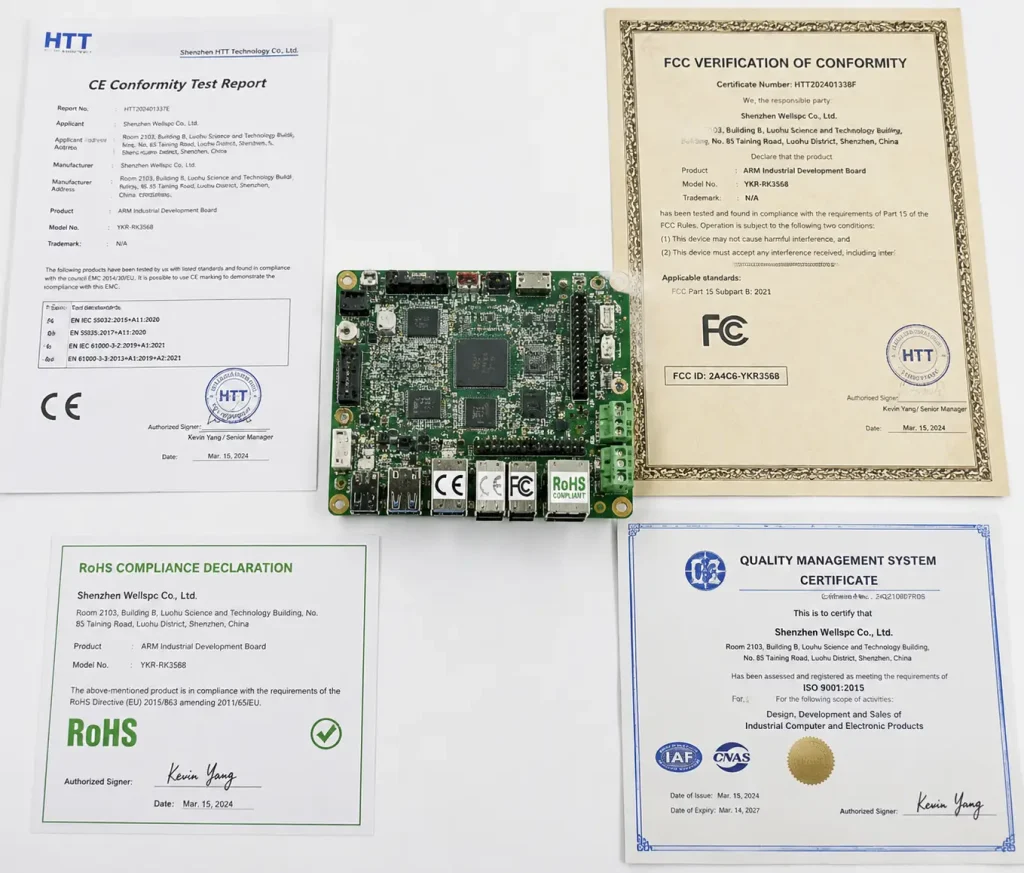
ieeker's embedded board certification package covers CE (EMC Directive + RoHS Directive), FCC Part 15B, and ISO 9001:2015 certification. Full test reports are available on request for all certified boards. They include the specific harmonised standards tested, the test laboratory details, and the exact board revision covered. We maintain written ECN notification policies. Hardware changes that affect EMC performance trigger a 60-day advance notification. Where required, a new EMC pre-compliance screen runs before the change ships.
For our complete framework on evaluating embedded board supplier quality and certification practices, see our embedded board manufacturer evaluation guide. It covers all eight criteria: hardware manufacturing, BSP support, component lifecycle, certifications, customisation, MOQ, engineering support, and post-sale lifecycle.
Need full certification documentation for your procurement review?
Request our complete certification package — CE DoC, FCC SDoC, RoHS declaration, and ISO 9001 certificate — for any ieeker board, with test reports included.
Request Certification Documentation →Frequently Asked Questions
Does a CE-certified development board mean my product is CE certified?
Not automatically. A CE mark on a board certifies the board as a component or sub-assembly in the configuration it was tested. Your finished product — with its enclosure, power supply, cables, and firmware — needs its own Declaration of Conformity. You can reference the board's CE documentation in your product's technical file, but the product-level DoC is your responsibility as the product manufacturer.
What is the difference between FCC Part 15B and FCC Part 15C?
Part 15B covers unintentional radiators — digital devices that produce RF as a byproduct of their normal operation. Part 15C covers intentional radiators — devices that transmit RF deliberately, like Wi-Fi, Bluetooth, and Zigbee modules. Part 15B can be self-certified via Supplier's Declaration of Conformity. Part 15C requires FCC ID certification through an accredited testing body, and generates the FCC ID number you can verify in the public database.
Do I need a new FCC certification if I change the board hardware?
It depends on what changed. Changes that alter RF emissions — processor, oscillator, memory type, or PCB layout — may require a new test. Changes that don't affect emissions — firmware updates, connector colour, mechanical fasteners — typically don't. The FCC provides guidance on which changes require retesting under its permissive change rules. When in doubt, a pre-compliance EMC scan ($500–1,500 at most RF labs) confirms whether emissions have changed before committing to a full certification run.
Is RoHS required in the US?
There is no federal RoHS law in the US. However, California's Electronic Waste Recycling Act restricts certain hazardous substances in covered electronic devices sold in California, with requirements that broadly align with EU RoHS. Some US procurement specifications — particularly defence, government, and large enterprise — explicitly require RoHS compliance as a contractual condition, regardless of legal mandate.
What does ISO 9001 certification actually mean for a board manufacturer?
ISO 9001:2015 certifies the manufacturer's quality management system — the processes they follow to design, manufacture, inspect, and deliver products. It doesn't certify the product itself or its performance. A manufacturer with ISO 9001 has demonstrated that their quality control processes are documented, followed, and periodically audited by an accredited third party. It's a baseline indicator of organisational quality maturity, not a product safety guarantee.
Sources & References
- Design for Certification: How to Build Embedded Systems Ready for ISO, CE, and FCC — Promwad
- FCC, CE, UL, RoHS: Global Electronic Certification Guide — Embien Technologies
- FCC Part 15 — Wikipedia
- Medical Device Regulation — Wikipedia
- What Certifications Are Used for New Electronic Hardware Products? — CAD Crowd