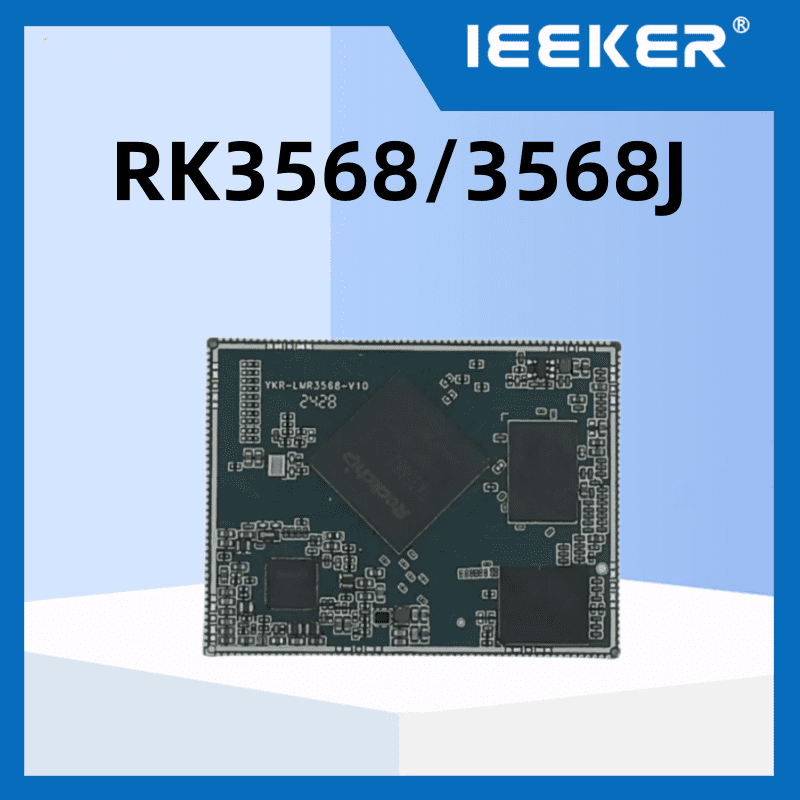
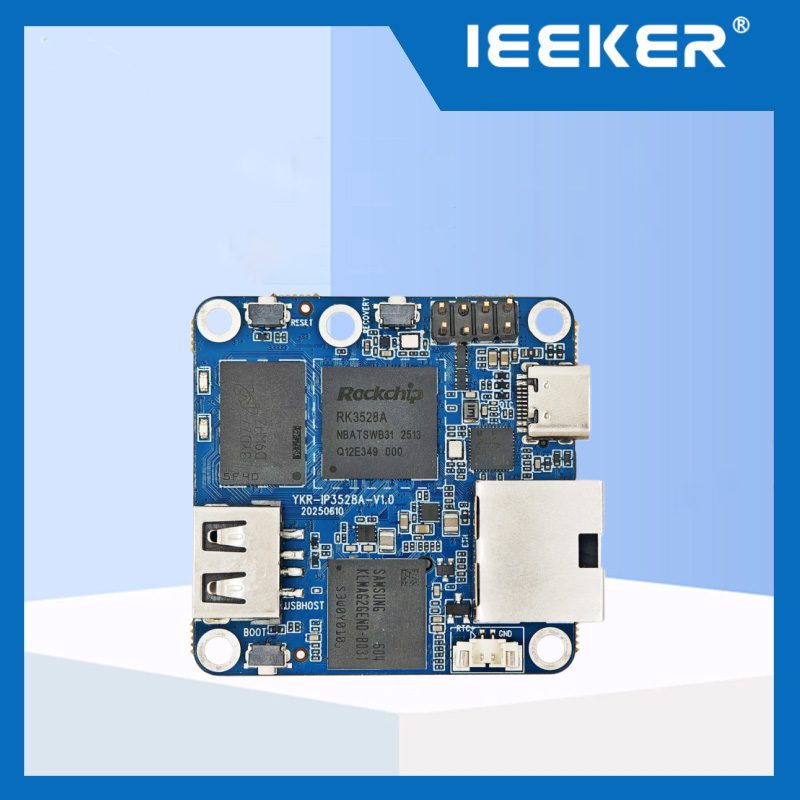
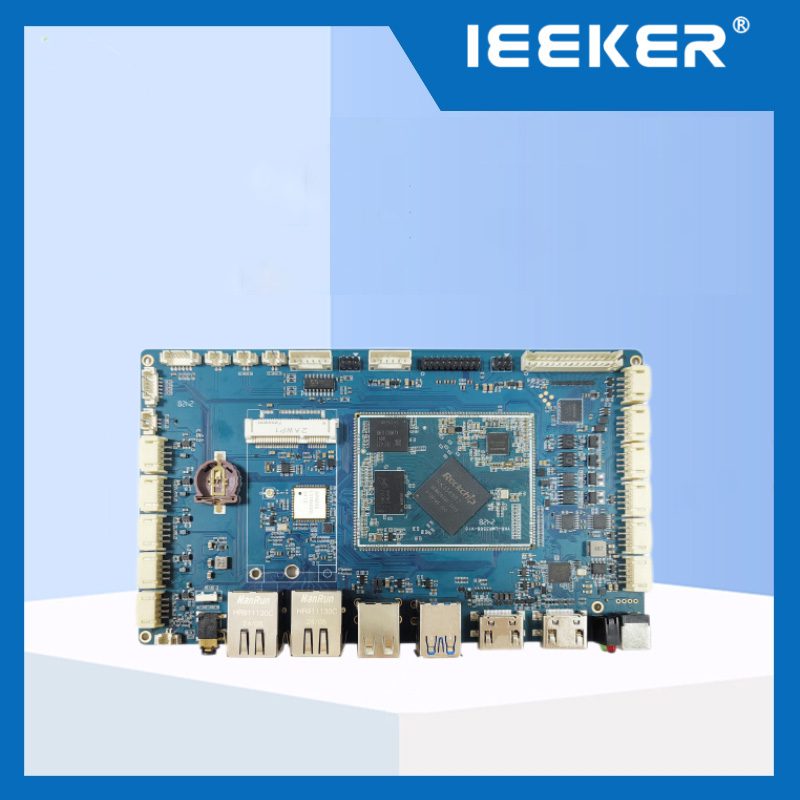
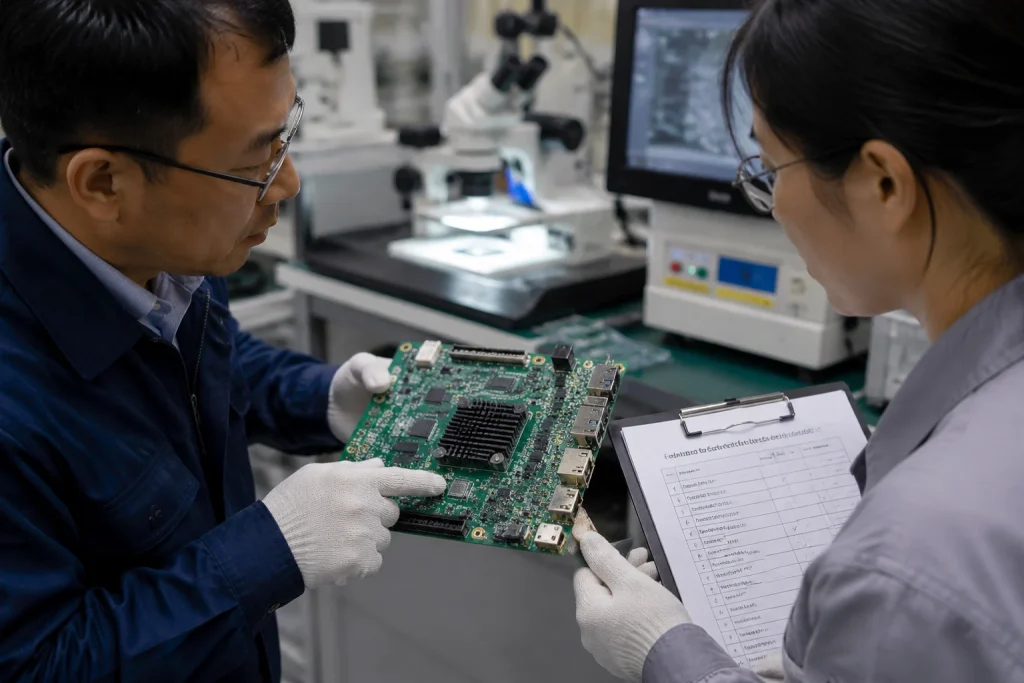
Answer: Evaluating an embedded development board manufacturer requires checking eight areas that generic supplier guides miss: hardware manufacturing capability, BSP and software support depth, long-term component supply commitment, certifications, customization workflow, minimum order flexibility, engineering responsiveness, and post-sale lifecycle management. Missing any one of these can derail a project months after the first prototype ships.
When an embedded project moves from prototype to production, the choice of hardware supplier becomes one of the highest-stakes decisions your team makes. The wrong embedded development board manufacturer doesn't just cause a delayed shipment — it can trigger BSP incompatibilities, force a board re-spin, or strand your product on a component that goes end-of-life eighteen months into a five-year program.
This guide gives engineers and sourcing managers a structured, criteria-by-criteria framework to separate credible industrial SBC suppliers from those who look good on a spec sheet but fall apart once the project scales. We've used these criteria with dozens of customers evaluating our own manufacturing capability — and we'll share the red flags each criterion reveals.
Key Takeaways
- BSP quality and kernel maintenance commitment are the most commonly underestimated evaluation criteria
- Component lifecycle guarantees matter more than unit price for any deployment lasting 3+ years
- Prototype NRE structure and MOQ flexibility reveal whether a supplier is built for your project stage
- CE, FCC, and industrial-grade certifications are non-negotiable for regulated markets — verify them independently
- Engineering response SLA during integration is the single biggest differentiator between suppliers at equal price points
- A supplier that can't provide a clear obsolescence management policy is a long-term liability
- Asking for customer references in your specific industry narrows the risk substantially
- The right supplier isn't necessarily the cheapest — it's the one whose failure modes won't cost you more than the savings
Why Generic Supplier Checklists Fail for Embedded Board Projects
Most procurement checklists are designed for commodity components or contract manufacturing. They ask about ISO 9001 status, on-time delivery rates, and pricing tiers. Those metrics matter for fasteners and molded plastic — they are insufficient for evaluating an embedded development board manufacturer.
An industrial SBC is not a passive component. It carries a processor, memory, power management ICs, and a set of firmware drivers that must work together across your specific operating system, kernel version, and peripheral configuration. When something breaks in production — a camera driver that locks up under memory pressure, a USB controller that fails on certain hub configurations, a GPU that doesn't initialize on cold boot below -10°C — the root cause is almost always traceable to BSP quality or component selection decisions made by the manufacturer, not the end customer.
Generic checklists don't ask about any of this. They verify certifications, check business registration status, and confirm the supplier can produce 1,000 units per month. None of those answers tell you whether the RK3588 board you're evaluating ships with a kernel that was last patched two years ago, or whether the MIPI CSI driver has a known race condition that only manifests with specific sensor timing.
The eight criteria below are designed specifically for embedded hardware sourcing. Each section includes the questions to ask, the answers to look for, and the red flags that signal risk before you've committed engineering hours.
Criterion 1 — Hardware Manufacturing Capability
The first question isn't whether a supplier makes embedded boards — it's whether they actually manufacture them or act as a reseller with a white-label arrangement. This distinction has serious implications for quality control, lead time, and your ability to request custom variants.
What to verify
- In-house SMT production lines: A manufacturer with its own Surface Mount Technology line controls placement accuracy, reflow profiles, and solder quality. Boards assembled at a third-party contract manufacturer lose traceability. Ask for factory photos with visible SMT equipment and request the machine model numbers (e.g., Yamaha YSM20, Fuji NXT III).
- AOI (Automated Optical Inspection) and X-ray: High-density ARM SBCs use BGA packages (Ball Grid Array) on the SoC and DDR memory. X-ray inspection is the only way to verify BGA solder quality. A supplier without in-house X-ray capability is relying on post-shipment defect detection rather than process control.
- Thermal and environmental test chambers: Industrial-grade boards should pass burn-in testing and temperature cycling. Ask whether the supplier runs 48-hour burn-in at elevated temperature (typically 60–70°C) before shipment, and whether they have a HALT/HASS chamber for accelerated life testing.
- Final pass rate and MTBF data: A credible manufacturer can provide a final pass rate (target: ≥99%) and MTBF estimates per board model. Suppliers without this data have not invested in statistical process control.
Red flags
- Marketing materials show "our factory" but photos are stock images
- Lead time quoted as 2–3 weeks for a custom board with no existing tooling (implying they're reselling someone else's design)
- No willingness to provide a factory audit visit, even virtual

Criterion 2 — BSP Quality and Software Support Depth
The Board Support Package (BSP) is the software layer that makes hardware usable — bootloader, kernel configuration, device drivers, and root filesystem. For an industrial embedded board, BSP quality determines whether your development team spends weeks integrating or months firefighting kernel panics and driver conflicts.
This is the criterion most engineering teams underweight because they evaluate hardware specifications first. By the time BSP problems surface, tooling fees have been paid and the project timeline is locked. A poorly maintained BSP — one with drivers that haven't been updated in 18 months, or a kernel version two major releases behind — is often worse than no BSP at all, because teams inherit bugs they didn't write and can't easily fix.
What to verify
- Kernel version and maintenance cadence: Ask which Linux kernel version ships with the board and when it was last updated. For Rockchip-based boards, a well-maintained BSP tracks the vendor BSP releases from Rockchip and applies security patches within 60–90 days. A kernel that's 18+ months stale on a production board is a security and stability risk.
- Supported OS images: Does the manufacturer provide tested images for multiple distributions? At minimum: Buildroot (for production-minimal deployment), Debian or Ubuntu (for development), and Android (if your product needs a UI framework). Images should include a tested image release date and changelog.
- Driver completeness checklist: Request confirmation that all on-board interfaces have validated drivers: camera (MIPI CSI), display (MIPI DSI / HDMI), NPU (for AI inference boards), GPU (OpenGL ES), USB 3.0, PCIe, and all UART/I2C/SPI/GPIO interfaces. "Driver available" and "driver stable under production load" are different claims.
- GitHub or SDK portal access: A serious embedded manufacturer maintains a public or customer-accessible SDK repository. Commit history tells you more about actual support quality than any marketing claim. Look for recent commits, issue responses, and versioned release tags.
- BSP customization service: For OEM projects, can the manufacturer deliver a customized kernel build with your specific peripherals integrated? What is the lead time and cost structure for BSP customization work?
Red flags
- BSP documentation is a single ZIP file with no version history or changelog
- Sales team cannot answer which kernel version ships, or escalates a basic software question to "technical team" without response for 48+ hours
- RKNN-Toolkit2 or equivalent AI inference SDK is "supported" but there are no example projects, no tested model zoo, and no inference benchmark data
Criterion 3 — Long-Term Component Supply and Lifecycle Commitment
Component availability is the silent killer of embedded product programs. A board that performs perfectly in year one can become unmanufacturable in year three when the PMIC or DDR variant it relies on goes end-of-life. For industrial deployments — where 5–10 year field lifetimes are the norm — this is not a theoretical risk. It is a documented pattern that affects tens of thousands of industrial devices every year.
The best industrial SBC suppliers address this proactively. As Gateworks, a US-based industrial SBC manufacturer, describes its approach: selecting processors and components with 10 to 15+ year availability guarantees is a design-phase requirement, not an afterthought. Rockchip industrial-grade SoCs (RK3588J, RK3568J) carry extended availability commitments specifically to serve this market.
What to verify
- SoC availability commitment: For Rockchip-based boards, ask whether the board uses the J-grade SoC variant (e.g., RK3588J vs. RK3588). J-grade parts are binned for extended temperature (-40°C to +85°C) and carry longer supply commitments from Rockchip.
- DRAM and eMMC sourcing: LPDDR4X and eMMC 5.1 are the most commonly substituted components in cost-down revisions. Ask whether the board has a fixed BOM or an "approved equivalent" policy. If the manufacturer can substitute memory vendors without notice, your firmware's timing calibration may break on a new batch.
- Obsolescence management policy: A credible supplier has a written Last Time Buy (LTB) notification policy — typically 12–18 months advance notice before a board variant is discontinued. Ask for this policy in writing before any contract.
- Inventory buffer programs: For high-volume OEM customers, some manufacturers offer bonded inventory — pre-purchasing your annual forecast quantities and holding them in a segregated warehouse. This eliminates exposure to spot market price spikes and allocation shortages.
From the Factory Floor: When a Customer Discovered a BSP Problem Three Months Into Production
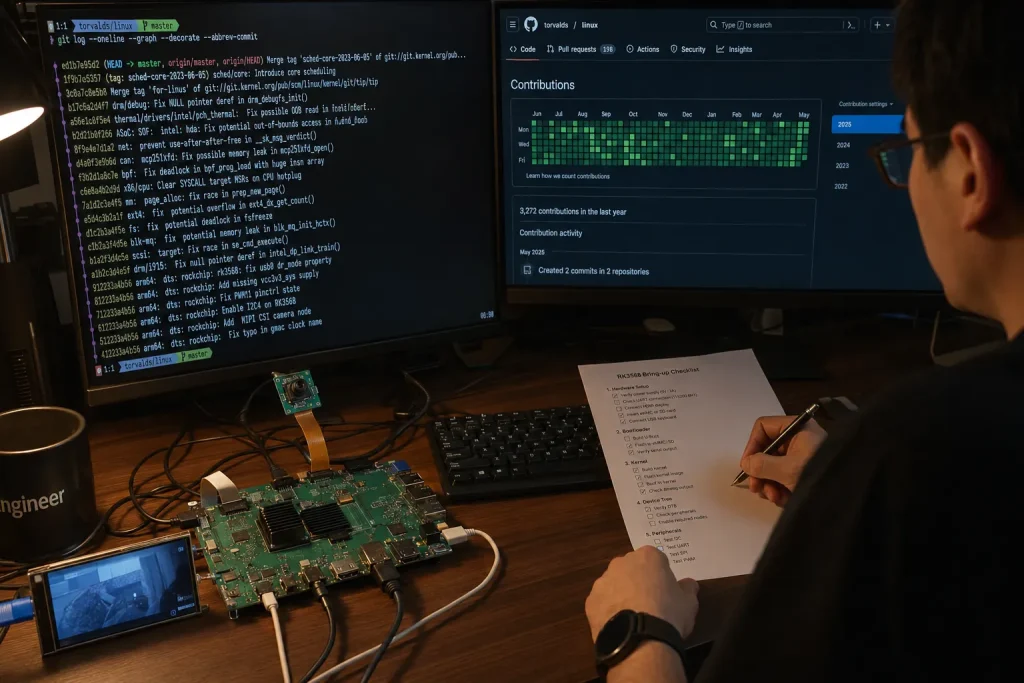
About two years ago, I was assigned to support a European industrial automation customer who had been running their HMI panels on a competing vendor's RK3568-based board for roughly 14 months. They came to us not for a new project, but because they were having a persistent problem they couldn't isolate: their Qt5 UI would occasionally freeze for 400–800ms during transitions between menu screens. It was intermittent — maybe once every 6–8 hours of continuous operation — but their customer was a machine tool manufacturer, and the operator HMI freezing mid-operation was a warranty issue.
Their previous supplier's engineering team had been "investigating" for eleven weeks. The advice they received was to increase Qt's rendering thread priority and reduce the number of animation effects. Both changes made the freeze less frequent but didn't eliminate it. The customer had 340 panels already deployed in the field and was staring at a potential recall.
When we analyzed their kernel build, the issue was immediately visible: their vendor had shipped a kernel with a non-upstream GPU memory management patch that had a known race condition under specific dma-buf allocation patterns. The patch had been flagged in the upstream Rockchip kernel mailing list eight months prior. Their vendor had never backported the fix because — as became clear — no one on their team was actively monitoring the upstream BSP. The board's BSP was essentially abandoned after initial release.
We delivered a patched kernel build within 72 hours of root cause confirmation. The customer flashed the fix to their 340 field units via OTA update. Zero freezes reported in the following three months. The lesson: you cannot evaluate a BSP by looking at documentation. You evaluate it by looking at who maintains it and how quickly they track upstream fixes. This is exactly why Criterion 2 — BSP maintenance cadence — belongs on every evaluation checklist before any tooling cost is committed.
Criterion 4 — Certifications: What's Real and What's Paperwork
Certifications are the most frequently misrepresented claim in embedded hardware procurement. "CE certified" means almost nothing without knowing which directives the CE mark covers, which test house issued the report, and whether the certificate covers the exact hardware revision you're purchasing.
For industrial embedded boards destined for European and North American markets, the minimum certification baseline includes:
| Certification | Covers | What to Verify |
|---|---|---|
| CE (EMC + LVD) | EU electromagnetic compatibility and low voltage | Request the full test report, not just the mark. Confirm it covers your exact SKU. |
| FCC Part 15B | US unintentional radiator EMC | Verify FCC ID in the public FCC database at fcc.gov/oet/ea/fccid |
| RoHS 2.0 (EU 2011/65/EU) | Restriction of hazardous substances in components | Request RoHS Declaration of Conformity with substance test results |
| ISO 9001:2015 | Quality management system | Verify certificate number and issuing body; check expiry date |
| REACH (EU 1907/2006) | Registration, evaluation, authorization of chemicals | Required for EU import; request SVHC (Substances of Very High Concern) declaration |
| UL 60950-1 / IEC 62368-1 | Audio/video, IT, and communications equipment safety | Required if your end product sells into North American markets; confirm whether board-level or system-level testing is needed |
Beyond the certifications listed above, industrial-grade applications may require IEC functional safety standards (IEC 61508 for general industrial, IEC 60601-1 for medical devices), or UN 38.3 battery transportation certification if your product integrates battery power. These are not certifications the board manufacturer typically holds — but they are constraints that affect which board you can select.
Red flags
- CE mark is on a marketing page but no test report available on request
- Certification covers a previous hardware revision (board has been updated since test)
- ISO 9001 certificate is expired or cannot be verified through the issuing body
Criterion 5 — Customization Workflow and NRE Structure
Most embedded projects start with a standard development board and evolve toward a custom board variant as the product matures. How a manufacturer handles this transition — the customization workflow, the non-recurring engineering (NRE) cost structure, and the prototype-to-production timeline — determines whether the process is manageable or painful.
The customization journey for a typical OEM project follows four stages: requirements definition → schematic review → prototype fabrication → validation → production sign-off. For a board customization (adding a connector, relocating ports, adjusting power rails), a credible manufacturer should be able to deliver first prototypes within 6–8 weeks. For a ground-up custom design built around a new SoC, 12–16 weeks for first silicon is realistic.
What to verify
- NRE fee structure: NRE covers schematic design, PCB layout, tooling, and firmware adaptation. A typical industrial SBC customization NRE runs from $3,000–$15,000 USD depending on complexity. Be cautious of suppliers with NRE below this range — it often means they're using a reference design with minimal real engineering, which surfaces as integration problems later.
- Design for Manufacturability (DFM) review: Does the manufacturer conduct a formal DFM review before fabrication? A DFM review catches trace width issues, component clearance violations, and thermal design problems before prototypes are built — saving 4–6 weeks on revision cycles.
- Prototype testing protocol: What validation tests are run on prototype units before customer delivery? At minimum this should include: power-on functional testing, thermal imaging at rated load, all interface connectivity verification, and a 24-hour burn-in.
- IP and NDA posture: Will the manufacturer sign a mutual NDA before schematic review? Do they have a clear policy on IP ownership for custom designs — specifically, who owns the schematic files, the PCB layout Gerbers, and the BSP modifications? These terms should be in writing before any money changes hands. Learn more about how ieeker handles custom development board design and IP protection.
Criterion 6 — MOQ Flexibility and Project Stage Fit
Minimum Order Quantity requirements reveal more about a supplier's target customer than any sales pitch. A supplier with a 500-unit MOQ on standard boards and a 2,000-unit MOQ on custom variants is structured for volume production customers. If your project is in early validation — buying 10–20 units for integration testing — that supplier's order management system and logistics infrastructure are not built for you, regardless of how friendly the sales team is.
The right MOQ structure aligns with your project's stage-gate milestones:
- Evaluation phase (1–5 units): Sample boards should be available for individual purchase or at nominal cost. A supplier who requires a signed PO for sample boards is adding friction to your risk reduction process.
- Integration / pilot phase (10–50 units): Low-volume purchase capability at this stage is critical. Suppliers with hard 100-unit minimums at this phase are asking you to commit capital before your integration validation is complete.
- Production phase (100–10,000+ units): This is where standard MOQ discussions become relevant. Confirm unit pricing breaks, lead time commitments at production volume, and whether the supplier can accommodate pull-based scheduling (releasing batches monthly rather than a single large order).
Also ask about mix flexibility: can you order two SKUs (e.g., 4GB and 8GB RAM variants) within a single production run, or does each variant require its own MOQ? This matters for products deployed across market tiers.
Criterion 7 — Engineering Support Responsiveness
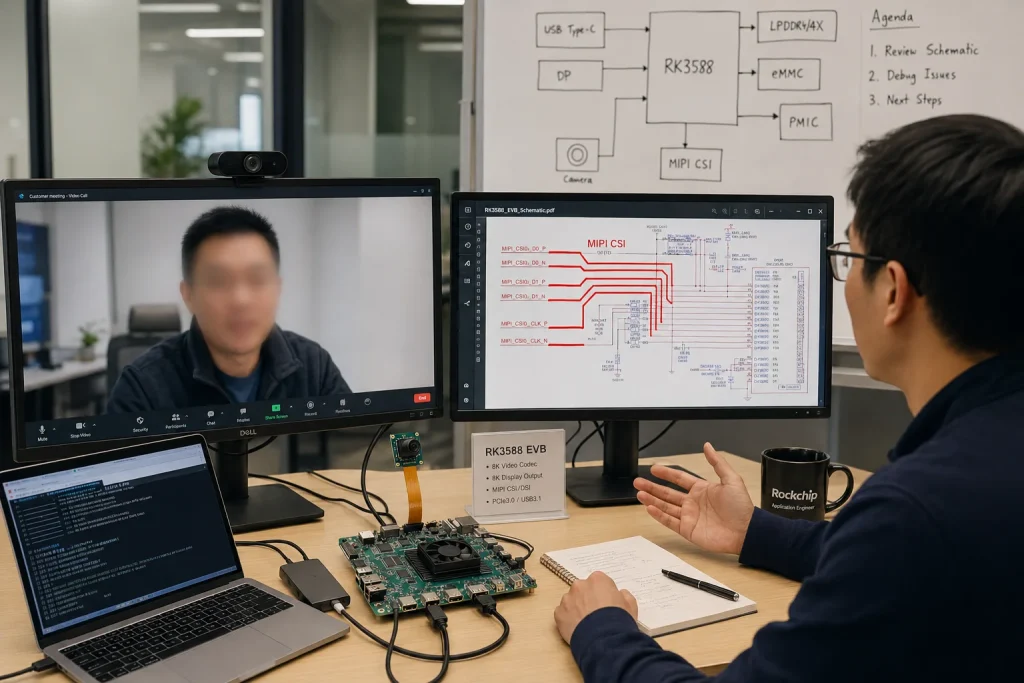
The single most impactful differentiator between embedded board suppliers at comparable price points is engineering support responsiveness. During integration — the phase when your team is connecting peripherals, debugging kernel drivers, and validating BSP behavior — the speed and quality of answers from the supplier's technical team directly determines your time-to-market.
This criterion is easy to test before committing: ask a technical question during the evaluation phase and measure the response. A supplier who takes four days to answer a question about MIPI CSI lane configuration during the sales process will take longer during integration, when your urgency is higher and their attention may be divided.
What to evaluate
- Dedicated engineer assignment: Does the supplier assign a named technical contact to your project, or does support go through a general ticketing queue? Named contact support eliminates context-rebuilding overhead on every interaction.
- Response SLA: Ask for their stated technical support SLA. Best-in-class industrial board suppliers target a 24-hour initial response on technical questions, with a 72-hour resolution target for driver-level issues. Compare this commitment against your integration timeline risk.
- Documentation quality: Review the supplier's technical documentation before purchase. A well-documented board has: a hardware design guide (schematic, pin mapping, interface specifications), an SDK user manual with working code examples, a known issues list, and an FAQ section that demonstrates real user interactions.
- Community or forum activity: Some suppliers maintain public forums or GitHub discussion threads where engineers ask and answer integration questions. Active community engagement is a strong proxy for support quality — it means the manufacturer's engineers are engaged with real integration challenges, not just shipping products.
Criterion 8 — Post-Sale Lifecycle Management
Most supplier evaluations focus entirely on the pre-sale and initial integration phase. Criterion 8 addresses what happens across the 3–7 year deployment window that follows: how does the manufacturer handle hardware revisions, security vulnerabilities, component substitutions, and end-of-life transitions?
Industrial deployments operate on entirely different assumptions than consumer electronics. A smart factory HMI, an IoT gateway, or a medical imaging device is not replaced annually. It runs continuously, often in environments where firmware updates require change control procedures and revalidation. This means the supplier's lifecycle management practices directly become your maintenance burden.
What to verify
- Hardware revision policy: When a supplier makes a PCB revision — even a "minor" component swap — does the customer receive advance notice? A change to a DRAM vendor, even within the same capacity and speed grade, can affect SPD timing tables and require firmware recalibration. Best practice: supplier issues an Engineering Change Notice (ECN) with at least 60 days advance notice and provides updated BSP if firmware changes are required.
- Security patch commitment: Linux kernel CVEs (Common Vulnerabilities and Exposures) affecting the board's kernel version should trigger a BSP update within a defined window. Ask the supplier for their security patch response policy. Suppliers without a defined policy are leaving your deployed fleet exposed.
- EOL (End-of-Life) notification lead time: What is the advance notice period before a board model is discontinued? Industry best practice is 12–18 months. During this window, customers should be able to submit a Last Time Buy order at the existing price. Confirm this policy is contractually specified, not just verbally assured.
- Repair and RMA program: For large deployed fleets, a structured board repair program (component-level rework, not just board swap) reduces lifecycle cost significantly. Ask whether the supplier offers depot-level repair, and what the typical repair turnaround time is.
Project Case: Onboarding a Southeast Asian IoT Gateway Manufacturer
One of the clearest demonstrations of lifecycle management value came from a project we ran for a Singapore-based IoT gateway company. They were deploying RK3568-based cellular gateways across a logistics network in Malaysia and Indonesia — 280 units in the first shipment, with a planned 600-unit expansion over 18 months.
Their previous supplier had discontinued the board variant they were using without the promised 12-month advance notice. They received a product discontinuation email 6 weeks before their planned production run for the expansion batch. With no Last Time Buy option available and the replacement board requiring a BSP migration, they were facing a $40,000 re-engineering effort and a three-month delay.
When they came to us, their first questions were not about specifications or pricing. They were about our EOL policy, our ECN notification lead time, and whether we maintained a bonded inventory program. We provided: a contractual 12-month EOL notice commitment, a written ECN policy specifying 60-day advance notice for hardware changes, and a bonded inventory arrangement covering their 18-month forecast.
The expansion batch shipped on schedule. Eighteen months into the deployment, we issued one ECN for a DRAM vendor substitution — 68 days advance notice, with updated BSP delivered simultaneously. The customer's firmware team spent half a day on recalibration validation. Zero field issues resulted. The total engineering cost of that transition was negligible compared to the disruption they had faced with their previous supplier.
The lesson this project taught clearly: lifecycle management criteria have the highest ROI of any evaluation criterion when measured over a 3–5 year program horizon. The savings from a $2/unit cheaper board evaporate entirely if a mid-program EOL forces a $40,000 re-engineering cycle.
Criterion 8 — Post-Sale Lifecycle Management
Most supplier evaluations focus entirely on the pre-sale and initial integration phase. Criterion 8 addresses what happens across the 3–7 year deployment window that follows: how does the manufacturer handle hardware revisions, security vulnerabilities, component substitutions, and end-of-life transitions?
Industrial deployments operate on entirely different assumptions than consumer electronics. A smart factory HMI, an IoT gateway, or a medical imaging device is not replaced annually. It runs continuously, often in environments where firmware updates require change control procedures and revalidation. This means the supplier's lifecycle management practices directly become your maintenance burden.
What to verify
- Hardware revision policy: When a supplier makes a PCB revision — even a "minor" component swap — does the customer receive advance notice? A change to a DRAM vendor, even within the same capacity and speed grade, can affect SPD timing tables and require firmware recalibration. Best practice: supplier issues an Engineering Change Notice (ECN) with at least 60 days advance notice and provides updated BSP if firmware changes are required.
- Security patch commitment: Linux kernel CVEs (Common Vulnerabilities and Exposures) affecting the board's kernel version should trigger a BSP update within a defined window. Ask the supplier for their security patch response policy. Suppliers without a defined policy are leaving your deployed fleet exposed.
- EOL (End-of-Life) notification lead time: What is the advance notice period before a board model is discontinued? Industry best practice is 12–18 months. During this window, customers should be able to submit a Last Time Buy order at the existing price. Confirm this policy is contractually specified, not just verbally assured.
- Repair and RMA program: For large deployed fleets, a structured board repair program (component-level rework, not just board swap) reduces lifecycle cost significantly. Ask whether the supplier offers depot-level repair, and what the typical repair turnaround time is.
Project Case: Onboarding a Southeast Asian IoT Gateway Manufacturer
One of the clearest demonstrations of lifecycle management value came from a project we ran for a Singapore-based IoT gateway company. They were deploying RK3568-based cellular gateways across a logistics network in Malaysia and Indonesia — 280 units in the first shipment, with a planned 600-unit expansion over 18 months.
Their previous supplier had discontinued the board variant they were using without the promised 12-month advance notice. They received a product discontinuation email 6 weeks before their planned production run for the expansion batch. With no Last Time Buy option available and the replacement board requiring a BSP migration, they were facing a $40,000 re-engineering effort and a three-month delay.
When they came to us, their first questions were not about specifications or pricing. They were about our EOL policy, our ECN notification lead time, and whether we maintained a bonded inventory program. We provided: a contractual 12-month EOL notice commitment, a written ECN policy specifying 60-day advance notice for hardware changes, and a bonded inventory arrangement covering their 18-month forecast.
The expansion batch shipped on schedule. Eighteen months into the deployment, we issued one ECN for a DRAM vendor substitution — 68 days advance notice, with updated BSP delivered simultaneously. The customer's firmware team spent half a day on recalibration validation. Zero field issues resulted. The total engineering cost of that transition was negligible compared to the disruption they had faced with their previous supplier.
The lesson this project taught clearly: lifecycle management criteria have the highest ROI of any evaluation criterion when measured over a 3–5 year program horizon. The savings from a $2/unit cheaper board evaporate entirely if a mid-program EOL forces a $40,000 re-engineering cycle.
The Supplier Scoring Framework: Putting the 8 Criteria Together
The criteria above can be assembled into a scoring matrix to compare multiple embedded board manufacturer candidates side-by-side. The weights below reflect typical industrial OEM program priorities; adjust them based on your project's specific risk profile.
| # | Criterion | Weight | Score 1 (Weak) | Score 5 (Strong) |
|---|---|---|---|---|
| 1 | Hardware Mfg. Capability | 15% | Reseller / contract assembled, no AOI | In-house SMT, X-ray, burn-in, 99%+ pass rate |
| 2 | BSP Quality & Maintenance | 25% | No version history, stale kernel | Active repo, <90d patch cadence, multi-OS images |
| 3 | Component Lifecycle | 20% | No EOL policy, consumer-grade components | J-grade SoC, 12-mo EOL notice, bonded inventory option |
| 4 | Certifications | 10% | CE mark only, no test reports available | CE + FCC + RoHS + ISO 9001, full reports on request |
| 5 | Customization Workflow | 10% | No NDA, vague IP terms, no DFM review | Mutual NDA, clear IP ownership, formal DFM review |
| 6 | MOQ Flexibility | 5% | Hard 500-unit MOQ at all stages | Single-unit samples, 10-unit pilots, flexible production batches |
| 7 | Engineering Support | 10% | Ticket queue, 5+ day response, no named contact | Named engineer, 24h initial response, active documentation |
| 8 | Post-Sale Lifecycle Mgmt. | 5% | No ECN policy, no security patch commitment | Written ECN policy, security patch SLA, repair program |
Score each supplier 1–5 per criterion, multiply by weight, sum total. Suppliers scoring below 3.0 weighted average carry significant program risk. Request a factory visit or audit for any supplier scoring below 4 on Criterion 2 (BSP) or Criterion 3 (Lifecycle) before committing NRE.
How ieeker Addresses Each Criterion
We built ieeker's manufacturing and support infrastructure around the criteria above because we built it with feedback from the customers who got burned by suppliers who couldn't meet them. Here is how we address each criterion directly:
- Hardware Manufacturing: In-house SMT production lines with AOI inspection on every board and X-ray available for BGA verification. 18 years of embedded hardware manufacturing in Shenzhen.
- BSP and Software: Maintained SDK portal with versioned kernel builds for Debian, Ubuntu, Buildroot, and Android. Active Rockchip BSP integration with security patch target of 60–90 days. BSP customization service available for OEM projects. See our RK3588 industrial board SDK documentation as a reference.
- Component Lifecycle: RK3588J and RK3568J industrial-grade SoCs with extended availability. Written 12-month EOL notification policy for all board variants. Bonded inventory available for annual forecast commitments of 500+ units.
- Certifications: CE (EMC Directive + LVD), FCC Part 15B, RoHS 2.0, REACH, and ISO 9001:2015. Full test reports available on request for all certified boards.
- Customization: NDA signed before schematic review. Clear IP ownership terms: your design files remain your property. DFM review included in NRE. Typical custom prototype lead time: 6–8 weeks. Explore our custom development board design guide for the full workflow.
- MOQ: Single-unit sample orders available for evaluation. Pilot runs from 10 units. Production MOQ starts at 50 units for standard boards.
- Engineering Support: Named application engineer assigned to OEM projects. 24-hour initial response commitment on technical questions. Direct email and WeChat/WhatsApp lines for integration-phase support.
- Lifecycle Management: Written ECN policy with 60-day advance notice on hardware changes. Security patch SLA documented in OEM agreements. Board repair service available for deployed fleets.
Ready to evaluate ieeker against your project requirements?
Share your specifications and we'll provide a technical response within 24 hours — covering BSP support, lifecycle commitment, and pricing for your volume tier.
→ Get a Free Technical Evaluation →Frequently Asked Questions
What is the most important criterion when evaluating an embedded board manufacturer?
For most industrial projects, BSP quality (Criterion 2) and component lifecycle commitment (Criterion 3) carry the most risk. Hardware specification failures are usually visible at prototype stage; BSP and lifecycle failures often don't surface until 12–24 months into production, when the cost of switching is very high. Weight these two criteria most heavily in your scoring.
What NRE cost is reasonable for a custom development board?
For a board customization based on an existing reference design (interface additions, form factor changes, connector relocation), NRE in the range of $3,000–$8,000 USD is typical. For a ground-up custom board built around a new SoC with full BSP adaptation, $10,000–$25,000 is a reasonable range depending on complexity. Unusually low NRE quotes (below $2,000 for a custom board) typically indicate the supplier is using a generic reference design with minimal real engineering — which creates BSP and integration risks downstream.
How do I verify that a CE certification is legitimate?
Request the full Declaration of Conformity document and the underlying EMC test report from the issuing test laboratory. The DoC must name the specific product model and hardware revision. Cross-check the test laboratory against the EU NANDO database (Notified Bodies for regulated products) or verify the lab's accreditation. A CE mark without a traceable test report is a self-declaration and carries no third-party verification.
What is a Board Support Package (BSP) and why does it matter for procurement?
A Board Support Package (BSP) is the software layer that enables an operating system to run on specific hardware — including the bootloader, kernel drivers, and filesystem configuration. For procurement decisions, BSP quality determines whether your team can successfully integrate the board with your peripherals, how stable the system is under production loads, and how maintainable the software is over the product's deployed lifecycle. A board with excellent hardware specifications but a poorly maintained BSP will cost more in engineering time than a slightly less capable board with a well-supported software stack.
What is a J-grade SoC and why does it matter for industrial deployments?
J-grade (or "industrial grade") designates SoC variants that have been tested and binned for extended temperature operation — typically -40°C to +85°C versus the 0°C to 70°C commercial range — and carry extended availability commitments from the chip manufacturer. For Rockchip, the RK3588J and RK3568J are the J-grade variants of their respective SoC families. Specifying a J-grade SoC is particularly important for deployments in outdoor environments, non-climate-controlled facilities, or markets where field replacement is expensive.
How much advance notice should a supplier give before discontinuing a board?
Industry best practice for industrial embedded components is 12–18 months advance end-of-life notification. This window allows OEM customers to evaluate alternatives, complete a Last Time Buy, or plan a board transition. Suppliers who cannot commit to a minimum 12-month EOL notice window in writing represent a supply chain risk for any deployment with a 3+ year expected product life.
Sources & References
- What Makes an Industrial Single Board Computer Truly Industrial? — Gateworks Corporation
- Supplier Evaluation and Selection Criteria Guide — Institute for Supply Management (ISM)
- Board Support Package — Wikipedia
- IEC Industrial Standards — International Electrotechnical Commission
- BSP Development Explained: Why It's the Backbone of Reliable Embedded Products — Medium
- 10 SBC Questions to Ask — Abaco Systems