
Short answer: Bu RK3588 vs Jetson Orin Nano decision comes down to three factors — budget, software ecosystem, and deployment environment. The ieeker YKR-RK3588 development board costs 40–50% less than a Jetson Orin Nano system, runs cooler at 5–8W versus Jetson's 15–25W, and covers every industrial interface without add-on hardware. The Jetson Orin Nano Super delivers 67 TOPS versus RK3588's 6 TOPS and brings NVIDIA's CUDA ecosystem — the right choice if your team already runs TensorRT pipelines or needs to deploy large language models at the edge. For the majority of industrial machine vision, IoT gateway, and embedded HMI applications, the YKR-RK3588 is the correct cost-performance decision.
Bu RK3588 vs Jetson Orin Nano comparison is the most common platform decision engineers face when scoping an edge AI project in 2026. Both boards target the same application space — computer vision, robotics, intelligent gateways, and industrial AI inference — yet they represent fundamentally different engineering philosophies: Rockchip optimizes for cost-efficient industrial deployment; NVIDIA optimizes for AI throughput and developer ecosystem depth.
This guide gives embedded engineers and hardware product managers a direct, criterion-by-criterion breakdown of the RK3588 vs Jetson Orin Nano trade-offs — CPU, GPU, NPU throughput, power consumption, industrial interfaces, software ecosystem, BOM cost, and production deployment considerations — so you can make the right platform call before the first prototype budget is committed.
Önemli Çıkarımlar
- RK3588 vs Jetson Orin Nano on NPU: 6 TOPS (RK3588) vs 67 TOPS (Jetson Orin Nano Super) — Jetson wins on raw AI throughput by 11×
- RK3588 wins on power: 5–8W typical versus Jetson Orin Nano's 15–25W — critical for passive-cooled industrial enclosures
- YKR-RK3588 development board costs 40–50% less than a comparable Jetson Orin Nano production system at volume
- RK3588 has 4× simultaneous display outputs, native CAN bus, SATA, and dual GbE — Jetson Orin Nano lacks all four natively
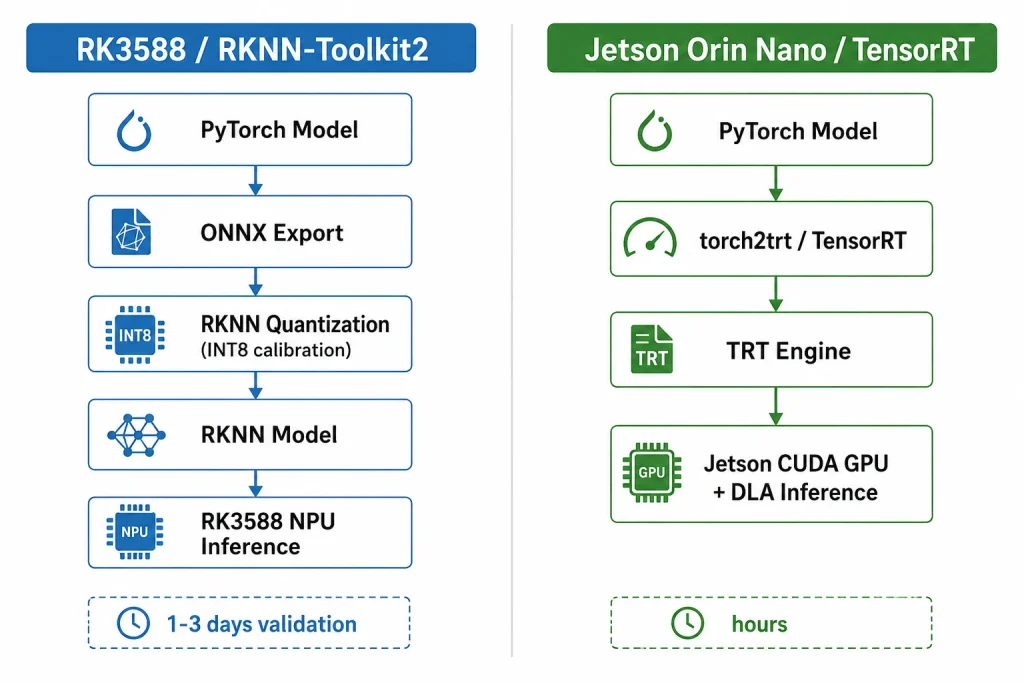
- CUDA + TensorRT + JetPack is the decisive advantage for Jetson: model deployment takes hours, not days, with NVIDIA's pre-optimized container ecosystem
- RK3588 RKNN-Toolkit2 supports PyTorch/ONNX → quantized INT8 inference: sufficient for 95% of industrial vision workloads at significantly lower system cost
- Jetson Orin Nano has a 4-unit purchase limit per account — not a production component; RK3588 boards are available in volume without allocation restrictions
- For generative AI edge deployment (LLMs, VLMs), Jetson Orin Nano Super is the only viable option at this price tier
RK3588 vs Jetson Orin Nano: Full Specification Comparison
Before the deep-dive analysis, here is the complete side-by-side specification map for the RK3588 vs Jetson Orin Nano comparison. The Jetson Orin Nano figures reflect the current Orin Nano Super (8GB) with JetPack 6.2 in MAXN Super mode.
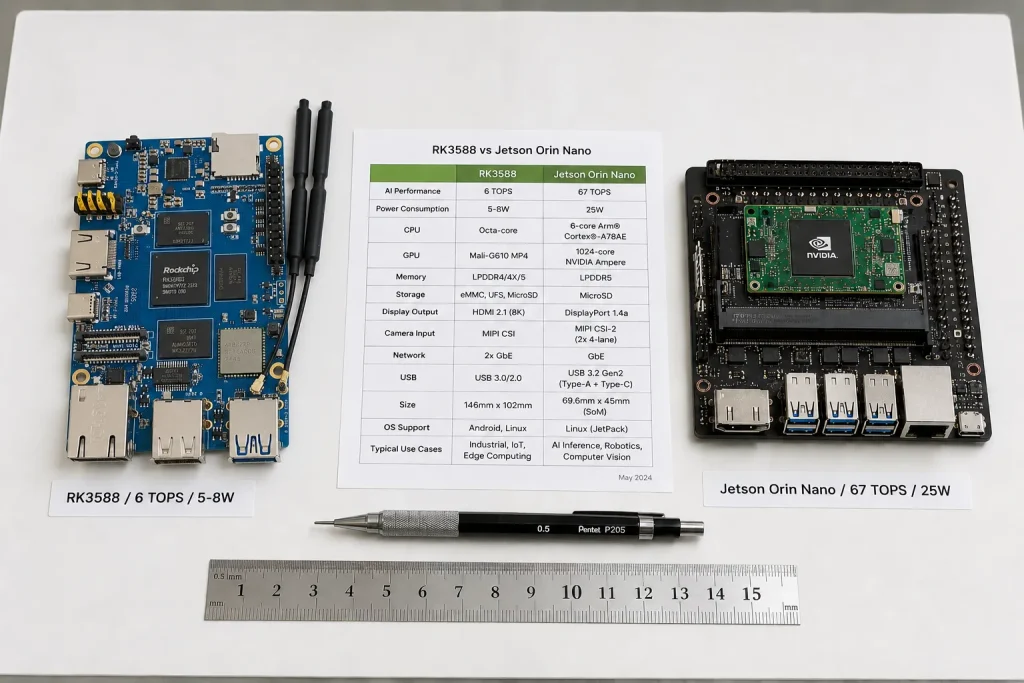
| Parameter | Rockchip RK3588 (ieeker YKR-RK3588) | NVIDIA Jetson Orin Nano Super (8GB, JetPack 6.2) |
|---|---|---|
| CPU | 8-core 4× Cortex-A76 @ 2.4GHz + 4× Cortex-A55 @ 1.8GHz | 6-core ARM Cortex-A78AE @ up to 1.5GHz |
| GPU | Mali-G610 MP4 OpenGL ES 3.2, Vulkan 1.2, OpenCL 2.2 | NVIDIA Ampere GPU 1024 CUDA cores, CUDA 11.4+, TensorRT |
| NPU / Yapay Zeka Hızlandırıcı | 6 TOPS (RKNN) | 67 TOPS (Super mode) |
| Hafıza | Up to 32GB LPDDR4X | 8GB LPDDR5 102 GB/s bandwidth (Super) |
| Typical power (load) | 5-8W | 15–25W (Super MAXN) |
| Video decode | 8K H.265 @ 60fps | 4K H.265 @ 60fps |
| Display outputs | Up to 4 simultaneous HDMI 2.1, DP 1.4, MIPI DSI ×2, eDP | 1 (DisplayPort only on dev kit) HDMI requires DP adapter |
| Ethernet | 2× 2.5GbE | 1× GbE |
| PCIe | PCIe 3.0 × 3 | PCIe 3.0 × 1 (M.2 key M) |
| SATA / CAN / RS-485 | SATA III ✅ / CAN ✅ / UART ✅ | None natively ❌ |
| Dev kit price | ~$120–160 (YKR-RK3588) | $249 (NVIDIA MSRP) |
| Production volume limit | No limit | 4 units/account (dev kit) Separate production module pathway |
| OS / software stack | Linux (Buildroot/Debian/Ubuntu), Android 12 | JetPack (Ubuntu-based) CUDA, TensorRT, cuDNN, DeepStream |
67 TOPS vs 6 TOPS: What the NPU Gap Actually Means for Your Project
The most cited number in the RK3588 vs Jetson Orin Nano comparison is the NPU throughput gap: 67 TOPS (Jetson Orin Nano Super in MAXN mode) versus 6 TOPS (RK3588). On paper, this looks like a decisive win for Jetson. In practice, what matters is whether your specific application actually requires 67 TOPS — and for the majority of industrial embedded workloads, it does not.
Here is what the RK3588's 6 TOPS NPU delivers in real industrial inference workloads using RKNN-Toolkit2:
- YOLOv5s object detection (INT8): ~45ms per frame at 640×640 input — approximately 22fps. Sufficient for conveyor belt defect detection, access control face recognition, and single-camera machine vision at standard industrial frame rates.
- MobileNetV2 image classification (INT8): ~12ms per inference — sufficient for high-frequency quality sorting at 80+ classifications per second.
- Lightweight anomaly detection (LSTM, 128 features): Sub-5ms per inference — suitable for real-time predictive maintenance on sensor streams at 200Hz polling rates.
- Multi-stream inference (2 camera feeds, YOLOv5s each): ~48fps combined across both streams using RKNN multi-core scheduling — viable for dual-camera inspection systems.
Where 6 TOPS is genuinely insufficient — and where the Jetson Orin Nano Super's 67 TOPS provides real value: running transformer-based vision models (ViT, CLIP), large language model inference at the edge (Llama 3 8B, Phi-3 Mini), multi-stream video analytics at 4K resolution, or simultaneous inference on 4+ camera feeds with ResNet-50 or larger backbones. As NVIDIA's documentation confirms, the Jetson Orin Nano Super delivers up to 1.7× generative AI model performance gains over its predecessor, enabling models like Llama 3 and vision-language models that are simply not practical on a 6 TOPS NPU.
The practical decision rule: if your inference workload fits within YOLOv5-class models at single-digit fps requirements, or your edge AI task is classification or anomaly detection rather than generative inference, the RK3588's 6 TOPS NPU is sufficient and the cost advantage is decisive. If you need to run LLMs, multi-modal models, or high-throughput multi-camera analytics, the Jetson Orin Nano Super's 67 TOPS is genuinely necessary. For a detailed breakdown of RK3588 NPU deployment using RKNN-Toolkit2, see our RK3588 NPU performans kılavuzu.
Power Consumption: Why RK3588 vs Jetson Orin Nano Matters for Industrial Enclosures
Power consumption is not a benchmark footnote for industrial deployments — it determines whether your device can be passively cooled, how large the power supply must be, and what the total operating cost looks like over a 5-year field deployment. The RK3588 vs Jetson Orin Nano gap here is significant and consistently favors the RK3588 in industrial enclosure scenarios.
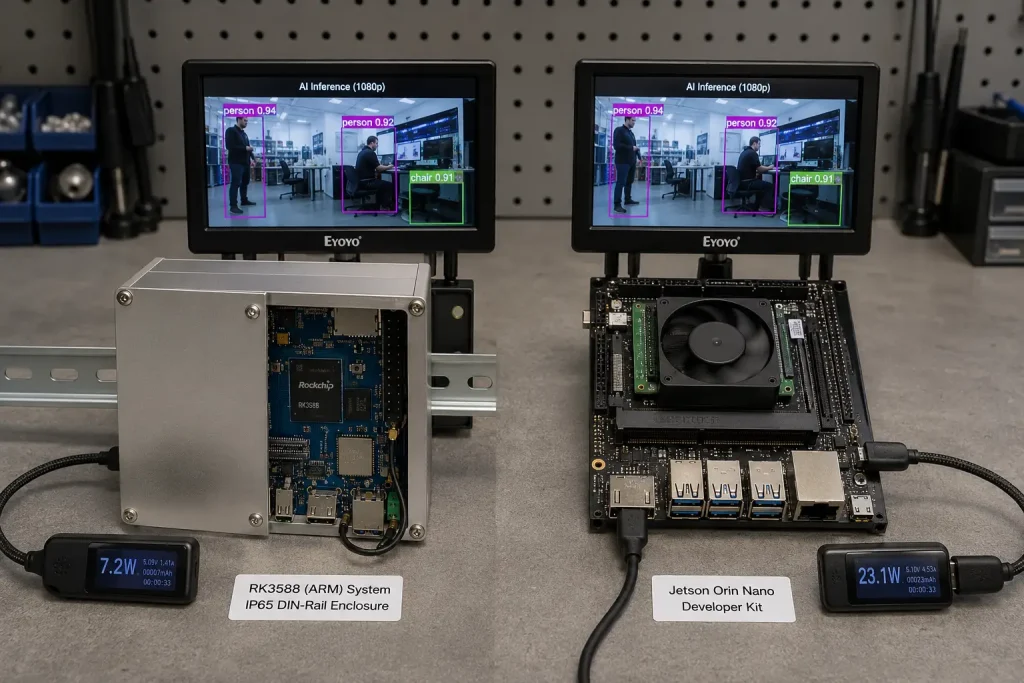
In typical edge AI workloads — NPU inference at 70% utilization with concurrent Linux services — the RK3588 consumes 5-8W total system power. This is confirmed by multiple independent measurements: at continuous NPU operation the RK3588 requires only passive cooling in properly designed enclosures, making fanless DIN-rail or IP65-rated deployments straightforward. The Jetson Orin Nano Super in MAXN mode draws up to 25W — more than three times the RK3588's load. At 15W (standard mode), it is still roughly double.
This has three direct engineering implications for industrial product design:
- Passive cooling feasibility: The YKR-RK3588 can be deployed in a sealed, fanless DIN-rail enclosure at up to 55°C ambient without exceeding junction temperature limits. The Jetson Orin Nano Super at 25W requires active cooling — a fan or liquid cooling solution — in any ambient above 35°C, adding cost, noise, and a mechanical failure mode to the product.
- Power supply sizing: RK3588 systems run comfortably on a 12V/1.5A (18W) industrial DIN-rail supply. Jetson Orin Nano requires a 5V/4A or 12V/2A supply rated for 25W+ — a larger, more expensive supply form factor.
- Battery-powered or PoE applications: For mobile robotics, drone payloads, or PoE-powered edge cameras, the RK3588's 5–8W envelope enables designs that the Jetson Orin Nano's power budget makes impractical.
From the Factory Floor: Why a Taiwan Vision System Company Chose RK3588 Over Jetson
About ten months ago, we worked with the hardware team at a Taiwanese machine vision company building a new generation of surface inspection systems for PCB manufacturing. Their existing system used Jetson Xavier NX boards — solid performance, but the platform was being discontinued and the transition to Jetson Orin NX for equivalent performance would have increased their system BOM by approximately $180 per unit. At 400 units per year, that was $72,000 in additional annual costs their product margin couldn't absorb.
Their inference workload: two 5MP GigE Vision cameras, YOLOv5m defect detection model at 10fps per camera, running continuously in a sealed inspection cabinet at up to 50°C ambient. Their threshold was simple — if the YKR-RK3588 could sustain 10fps per camera with acceptable defect detection accuracy, the economics made the switch mandatory.
We supplied two YKR-RK3588 evaluation boards within the week. Their ML engineer quantized their YOLOv5m model to INT8 using RKNN-Toolkit2 — the process took three days, including a one-day accuracy validation pass to confirm the quantized model maintained defect detection precision above their 98.5% threshold. Final performance: 11.2fps per camera sustained at 85% NPU utilization, with GPU handling the GigE Vision frame buffer in parallel. The accuracy delta from FP32 to INT8 was 0.3% — well within their specification.
Thermal result: the YKR-RK3588 in their sealed enclosure at 50°C ambient reached 72°C junction temperature under continuous load — within the RK3588's rated operating range with passive heatsink only. Their previous Jetson Xavier NX system had required a 60mm fan that triggered maintenance alerts every 18 months due to lint contamination from the PCB production environment. The fanless RK3588 design eliminated that maintenance point entirely.
They have now shipped 320 units of their redesigned inspection system. Per-unit BOM saving versus the Jetson Orin NX alternative: $163. Total annual saving at current volume: $65,200. The RKNN-Toolkit2 model migration took three engineer-days — a one-time cost paid back entirely in the first two months of production.
Industrial Interfaces: Where RK3588 Has No Competition
For engineers evaluating the RK3588 vs Jetson Orin Nano for industrial deployments — IoT gateways, embedded HMI panels, NVR systems, factory automation nodes — the interface comparison is as important as the compute comparison. The RK3588 was designed for industrial embedded applications; the Jetson Orin Nano was designed for AI development and robotics prototyping. This difference is visible in the hardware.
The ieeker YKR-RK3588 development board provides natively, without any expansion cards:
- Dual 2.5GbE: Independent MACs for LAN/WAN separation in gateway deployments — the Jetson Orin Nano developer kit has one GbE port only.
- SATA III: Direct 2.5" SSD connection for local data historian — not available on Jetson Orin Nano without a PCIe SATA controller card consuming the single M.2 slot.
- CAN bus: For PLC, actuator, and vehicle bus communication — requires a USB-CAN or PCIe adapter on Jetson.
- Multiple UART / RS-485: For Modbus RTU fieldbus polling — requires USB-serial adapters on Jetson that add latency and failure points.
- 4 simultaneous display outputs: HDMI 2.1 + DP 1.4 + 2× MIPI DSI for multi-panel HMI configurations — Jetson Orin Nano developer kit outputs to DisplayPort only (HDMI requires an adapter, as documented by multiple users).
- PCIe 3.0 × 3: Enables simultaneous 4G/5G modem + NVMe SSD + additional peripheral — Jetson has one PCIe 3.0 M.2 slot.
For a detailed deployment architecture of the YKR-RK3588 in IoT gateway configurations — Modbus to MQTT stack, cellular uplink, store-and-forward design — see our RK3568 industrial IoT gateway guide; the same architecture applies to RK3588 with higher compute headroom for concurrent NPU inference workloads.
RK3588 vs Jetson Orin Nano: Software Ecosystem and AI Deployment Toolchain
The software ecosystem difference between RK3588 vs Jetson Orin Nano is the most significant factor for teams that prioritize rapid AI model deployment over hardware cost or power efficiency.
NVIDIA JetPack: The Deployment Speed Advantage
JetPack is NVIDIA's unified software platform for Jetson — it bundles Ubuntu Linux, CUDA, cuDNN, TensorRT, DeepStream (multi-stream video analytics), and Isaac ROS (robotics middleware) into a single SDK installation. A PyTorch-trained model deploys to TensorRT-optimized inference on Jetson in a single conversion command. Pre-built Docker containers for popular frameworks (Ultralytics YOLO, Hugging Face Transformers, NVIDIA Triton inference server) run directly from NVIDIA's container registry without custom build steps.
For robotics applications specifically, NVIDIA's Isaac ROS on Jetson Orin Nano provides hardware-accelerated ROS 2 nodes, stereo depth processing, and SLAM that would require significant custom development to replicate on RK3588. If your product is a ROS 2 robot, Jetson is the correct choice unless budget constraints are overriding.
RKNN-Toolkit2: Capable for Industrial Inference, Requires More Setup
The RK3588's inference path — RKNN-Toolkit2 — converts PyTorch, TensorFlow, or ONNX models to a quantized RKNN format that runs on the NPU. The workflow is well-documented and the toolkit is actively maintained, but it requires explicit quantization calibration (providing a representative dataset for INT8 calibration) and validation of accuracy after quantization. This is a one-time per-model investment of 1–3 engineer-days, not a recurring cost.
Key RKNN-Toolkit2 strengths for industrial deployments: the quantized RKNN model format is highly deterministic (same inference result on every run, no GPU scheduling variability), models trained on RK3568 NPU deploy identically on RK3588 NPU with no re-quantization, and the RKNN Python API integrates cleanly with OpenCV and industrial camera SDKs.
The honest limitation: RKNN-Toolkit2 does not support transformer-based architectures as efficiently as TensorRT — attention operations in ViT and LLM models run partially on CPU rather than NPU, significantly limiting throughput for generative AI workloads. If your application requires edge LLM inference or vision-language models, Jetson's CUDA + TensorRT stack is the only viable option at this price tier.
BOM Cost and Production Deployment: The Commercial Reality
The commercial context of the RK3588 vs Jetson Orin Nano decision matters as much as the technical comparison, especially for teams planning to ship products rather than build prototypes.
Development Kit vs Production Component
The Jetson Orin Nano Super Developer Kit at $249 is explicitly a development and prototyping tool — NVIDIA limits purchases to 4 units per customer account for R&D use. Production deployment of Jetson-based products requires sourcing the bare Jetson Orin Nano module (priced separately, typically $150–200 at volume) plus a custom or third-party carrier board, plus JetPack licensing for commercial software features. This adds design cost, carrier board NRE, and a more complex supply chain compared to ordering production volumes of the YKR-RK3588 directly.
The ieeker YKR-RK3588 development board is a production-ready component with no unit quantity restrictions. The same board used for prototyping is the board that ships in production — no module swap, no carrier board redesign, no separate production BOM. For OEM programs requiring custom form factors, our RK3588 SoM + carrier board service follows the same production pathway as the YKR-RK3568 platform. See our Özel geliştirme kartı tasarım kılavuzu for the full OEM workflow.
Total System Cost at 500 Units/Year
| Cost Item | YKR-RK3588 System | Jetson Orin Nano System |
|---|---|---|
| Compute board @ 500 units | ~$120–140 | ~$175–200 (module only) |
| Carrier board (production) | Included | $30–60 additional (3rd-party) |
| Active cooling (fan/heatsink) | $0 (passive only at ≤55°C) | $8–15 (required at 25W) |
| Power supply (industrial DIN-rail) | $12–18 (12V/1.5A) | $20–28 (12V/2.5A+) |
| Estimated system total | ~$132–158 | ~$233–303 |
| Delta per unit @ 500/year | $75–145 savings with RK3588 — $37,500–72,500/year | |
RK3588 vs Jetson Orin Nano: The Decision Guide
Choose the ieeker YKR-RK3588 if:
- Your AI workload is YOLOv5/v8-class detection or classification at ≤30fps — 6 TOPS is sufficient and RKNN-Toolkit2 is a manageable one-time migration
- Your deployment requires passive cooling — sealed DIN-rail enclosures, outdoor kiosks, or any environment where a fan is a maintenance liability
- Your product needs industrial interfaces natively: dual GbE, CAN bus, RS-485, SATA, multiple display outputs — adding these to Jetson via USB adapters introduces reliability and latency risks
- Your BOM target is under $160/unit at ≤1,000 unit volumes, or the $75–145/unit saving materially affects your product margin
- You need production quantities without allocation restrictions — the 4-unit dev kit limit on Jetson means production requires a separate procurement pathway
- Your OS requirement includes Android or a non-JetPack Linux distribution — the YKR-RK3588 ships with Android 12, Debian, Ubuntu, and Buildroot images
Choose the Jetson Orin Nano Super if:
- Your application requires generative AI at the edge — running LLMs (Llama 3 8B), VLMs (LLaVA), or vision transformers that need 67 TOPS and CUDA for viable throughput
- Your team is already in the NVIDIA ecosystem — TensorRT pipelines, DeepStream multi-camera analytics, or Isaac ROS robotics middleware already in production
- You need ROS 2 with hardware-accelerated perception — Isaac ROS on Jetson provides SLAM, stereo depth, and object detection nodes that would require significant custom work on RK3588
- Your inference workload requires 4+ concurrent camera streams at ResNet-50 or larger backbone — the CUDA GPU's parallel throughput handles this efficiently where RKNN would require careful resource partitioning
- Budget is not the primary constraint and fastest time-to-working-demo is the priority — JetPack's pre-built container ecosystem gets you running faster than RKNN setup
IEEKER YKR-RK3588 for Industrial Edge AI
The ieeker YKR-RK3588 development board is ieeker's production-ready RK3588 platform — in-house SMT manufacturing, validated BSP (Debian 11, Ubuntu 22.04, Android 12, Buildroot), RKNN-Toolkit2 SDK documentation, and direct engineering support for model migration questions. For teams evaluating the RK3588 vs Jetson Orin Nano decision, we supply single-unit evaluation boards with full SDK access and can provide RKNN model conversion support for your specific inference workload.
For projects where 6 TOPS is genuinely insufficient and the Jetson Orin Nano's $249 + carrier cost is acceptable — particularly generative AI or heavy multi-stream analytics — the Jetson platform is the right answer and we will say so. But for the majority of industrial machine vision, edge inference, and IoT gateway applications, the YKR-RK3588 delivers the correct trade-off between AI capability, industrial interface coverage, power budget, and deployment cost.
Evaluating RK3588 vs Jetson Orin Nano for your application?
Share your inference model and deployment environment — we'll run a quick RKNN feasibility check and tell you honestly whether RK3588's 6 TOPS is sufficient for your workload.
→ Request YKR-RK3588 Evaluation Board →Sıkça Sorulan Sorular
Is RK3588 better than Jetson Orin Nano for industrial applications?
For most industrial applications — machine vision at standard frame rates, IoT gateways, HMI panels, and embedded control systems — yes. The RK3588 provides better industrial interface coverage (dual GbE, CAN, SATA, RS-485), lower power consumption enabling passive cooling, and 40–50% lower system BOM cost. The Jetson Orin Nano Super is better for generative AI workloads (LLMs, VLMs) and ROS 2 robotics where NVIDIA's CUDA ecosystem provides decisive deployment speed advantages.
Can I run YOLO on RK3588?
Yes. YOLOv5s, YOLOv5m, YOLOv8n, and YOLOv8s have all been validated on the RK3588 NPU via RKNN-Toolkit2 with INT8 quantization. YOLOv5s achieves approximately 45ms per frame (22fps) on the NPU alone. YOLOv5m runs at approximately 65–80ms per frame (12–15fps). For defect detection, face recognition, and general industrial object detection at standard industrial frame rates, these speeds are sufficient.
What is the RK3588 vs Jetson Orin Nano power difference in real use?
Under typical edge AI inference workloads (NPU at 70% utilization, dual GbE active, Linux OS services), RK3588 draws 5–8W total system power. The Jetson Orin Nano Super in standard 15W mode draws 15W; in MAXN Super mode it draws up to 25W. In practical terms: RK3588 can be passively cooled in an industrial enclosure up to 55°C ambient; Jetson Orin Nano requires active cooling above approximately 35°C in an enclosure.
Does Jetson Orin Nano work without JetPack?
Technically yes — standard Ubuntu runs on Jetson Orin Nano, but without JetPack you lose access to CUDA, TensorRT, cuDNN, DeepStream, and all NVIDIA-specific AI libraries. Running Jetson Orin Nano without JetPack for AI workloads defeats its primary purpose. For teams that need a standard Linux environment without NVIDIA dependencies, RK3588 with Debian or Ubuntu provides a simpler and lower-cost solution.
How long does RKNN model conversion take?
The RKNN-Toolkit2 conversion process for a standard YOLOv5 or YOLOv8 model takes approximately 1–3 engineer-days including: ONNX export from PyTorch (~1 hour), RKNN quantization calibration with representative dataset (~4–8 hours depending on dataset size), accuracy validation between FP32 and INT8 models (~4 hours), and integration into the production inference pipeline (~1 day). This is a one-time per-model cost; subsequent deployments of the same model require no reconversion.
Can RK3588 run large language models?
Small quantized language models (1–3B parameters, 4-bit quantized) can run on RK3588 using llama.cpp with CPU inference — typically at 2–5 tokens/second, which is viable for offline keyword extraction or simple Q&A but too slow for interactive applications. The 6 TOPS NPU does not accelerate transformer attention layers efficiently. For production edge LLM deployment, the Jetson Orin Nano Super's 67 TOPS with TensorRT-LLM optimization is the appropriate platform at this price tier.
Kaynaklar & Referanslar
- NVIDIA Jetson Orin Nano Super Developer Kit — NVIDIA Official
- Jetson Orin Nano Super Performance Boost — NVIDIA Developer Blog
- Solving Entry-Level Edge AI Challenges with Jetson Orin Nano — NVIDIA
- RK3588 vs Jetson Orin Nano Real-World Comparison — DEV Community
- RKNN-Toolkit2 — Rockchip NPU Inference SDK — GitHub
- Large Language Model — Wikipedia