The Rockchip RK3588 is Rockchip’s flagship high-performance system-on-chip (SoC), widely adopted for edge AI, embedded computing, machine vision, digital signage and industrial control. Since its release, it has become a top choice for embedded engineers, system integrators and hardware manufacturers. Developers commonly search for its hardware specifications, official datasheet, compatible operating systems, open-source GitHub resources and the RK3588M variant when evaluating embedded project solutions.
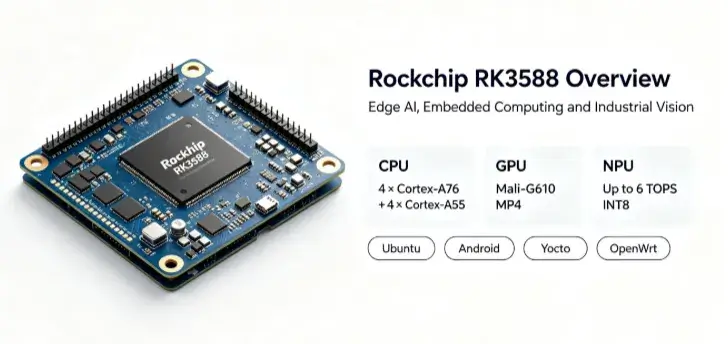
This practical guide draws on Rockchip official documentation, validated community development workflows and real-world field deployment experience. It breaks down hardware specs, supported operating systems, NPU inference capability and where to access reliable open-source code, helping technical teams judge whether the RK3588 matches their project requirements.
1. Rockchip RK3588 Core Specifications
Built on an 8nm manufacturing process, Rockchip RK3588 uses a big.LITTLE heterogeneous CPU architecture: 4×Cortex‑A76 high-performance cores paired with 4×Cortex‑A55 low-power cores. It integrates an ARM Mali-G610 MP4 GPU for graphics rendering and hardware video encoding and decoding.
Its standout feature is the built-in NPU, delivering up to 6 TOPS INT8 computing power. The NPU supports INT4, INT8 and INT16 mixed-precision inference, making it ideal for edge AI workloads such as object detection, industrial defect inspection, image classification and real-time video analytics.
Rich peripheral interfaces including PCIe, SATA, USB 3.0, MIPI CSI and MIPI DSI are integrated into the chip. It supports 8K hardware decoding and multi-screen independent display output, giving hardware designers flexibility for custom embedded boards, digital signage controllers and industrial vision devices.
RK3588M is a derivative version of the standard RK3588. It is tuned for low-power, cost-sensitive embedded applications with adjusted peripherals and performance. Hardware designers should compare parameter differences via official documentation before schematic development.
2. Rockchip RK3588 Datasheet: Access Authoritative Hardware Documentation
The official Rockchip RK3588 datasheet is the primary reference for hardware design. It contains absolute maximum electrical ratings, parameter tables, pin definitions, timing diagrams and peripheral function descriptions, which are essential for schematic and PCB design.
Official datasheets are distributed through Rockchip authorized channels and licensed chip distributors. Engineers purchasing RK3588 chips or off-the-shelf single-board computers can request formal datasheets and hardware reference manuals from suppliers.
Third-party PDFs from unknown forums or file-sharing platforms may contain outdated or incorrect parameters, which can lead to hardware damage if used for product design.
3. Supported Operating Systems for Rockchip RK3588
Flexible multi-OS compatibility is one of the main reasons behind RK3588’s popularity. The most widely ported systems include Ubuntu, Android, Yocto and OpenWrt, each targeting distinct development scenarios.
3.1 Rockchip RK3588 Ubuntu
Ubuntu is the preferred OS for AI algorithm developers. Official and community-built Ubuntu images for RK3588 are available in desktop and headless server variants, with pre-adapted kernel drivers. Developers can deploy deep learning models directly, work with RKNN-Toolkit2, and run machine vision pipelines. It is heavily used for prototype verification, edge AI testing and industrial data acquisition.
3.2 Rockchip RK3588 Android
RK3588 Android firmware is commonly deployed in commercial digital signage, smart kiosks and interactive display terminals. Rockchip’s BSP supports Android 12 and newer versions, with optimized multimedia decoding, touch drivers and display stacks. Product teams building customer-facing display hardware choose Android for its mature app ecosystem.
3.3 Rockchip RK3588 Yocto
The Yocto Project is favored by industrial product teams. Developers can build lightweight, customized Linux images, stripping unnecessary components to reduce system footprint, boost stability and shorten boot time. Yocto-based RK3588 builds are typical for long-lifecycle industrial equipment requiring locked kernel and software versions.
3.4 Rockchip RK3588 OpenWrt
OpenWrt ports for RK3588 target network embedded hardware such as high-performance edge gateways and data relay nodes, leveraging the chip’s PCIe and high-speed Ethernet peripherals. Unlike traditional router SoCs, RK3588 running OpenWrt adds local edge AI capability for on-network data classification and analysis.
4. Rockchip RK3588 GitHub Open-Source Resources
Many embedded developers seek Rockchip RK3588 GitHub repositories. Rockchip hosts official kernel, U-Boot and driver source code on GitHub. The ecosystem also includes community projects: pre-built firmware, device tree overlays, RKNN AI model samples and peripheral test code.
When using GitHub resources, separate official Rockchip repositories from community forks. Official repos receive ongoing security patches and hardware compatibility updates. Community projects work well for reference and prototyping, but need full validation before mass commercial production.
5. Rockchip RK3588 NPU for Edge AI Deployment
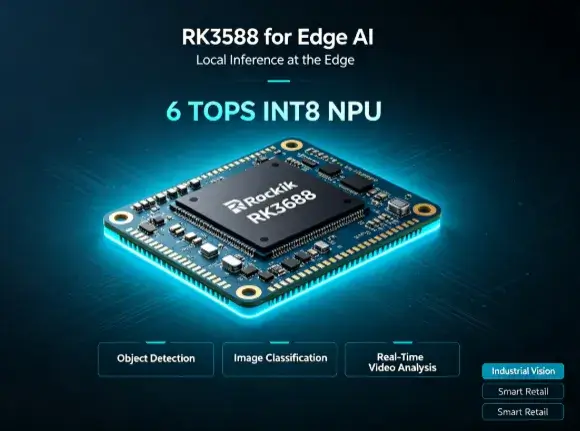
The RK3588 NPU is the core advantage of this SoC. Paired with the official RKNN-Toolkit2 toolchain, developers can convert trained PyTorch, TensorFlow and ONNX models into RKNN format to run local inference.
Running AI models locally on the RK3588 NPU cuts cloud transmission latency and protects raw on-site data privacy. Typical use cases cover factory visual defect detection, IP camera object recognition, smart retail analytics and real-time video processing.
Conclusion
Rockchip RK3588 remains a versatile high-performance embedded SoC built for edge AI and industrial embedded development. Project evaluators should start from official datasheets and hardware specs, then select an operating system matching their use case: Ubuntu for algorithm development, Android for interactive displays, Yocto for customized industrial firmware, and OpenWrt for edge network gateways.
Open-source GitHub code speeds up prototype development, while the RK3588M variant offers an alternative for projects with tight power and budget constraints. For commercial product development, always test firmware, NPU inference performance and peripheral functions on verified single-board hardware and refer to Rockchip’s official technical support channels.