Introduction
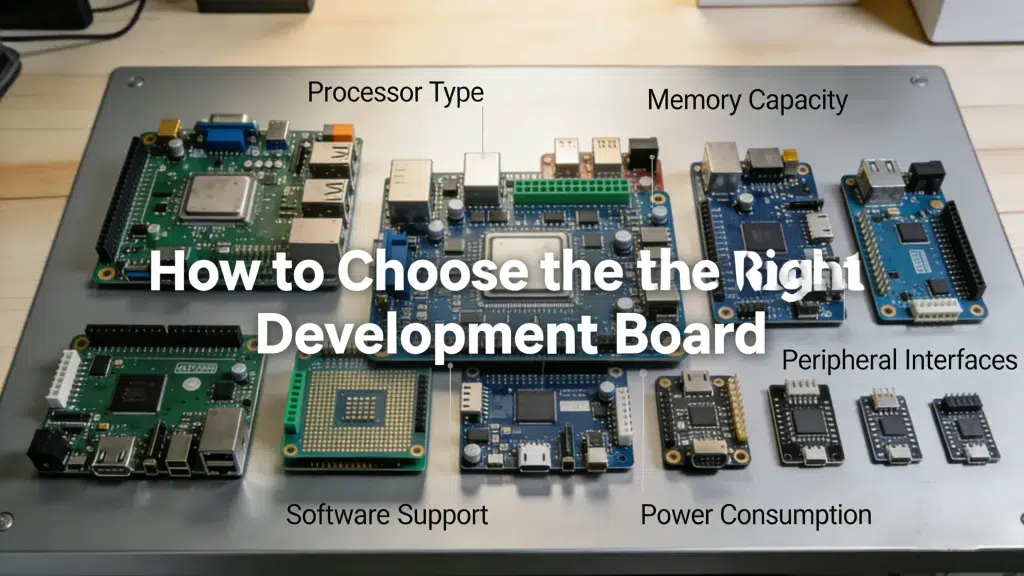
Choosing the right development board is a critical first step in building embedded systems, industrial applications, IoT devices, or AI-powered solutions. With so many options available on the market—different processors, memory configurations, interfaces, and operating system support—it can be challenging to identify the best board for your specific project.
This guide from ylwwpc will walk you through the key factors to consider when selecting a development board, helping engineers, system integrators, and product managers make informed decisions while avoiding common pitfalls.
1.Define Your Application Scenario
Before comparing specifications, the first question you should ask is:
What is the development board going to be used for?
Different application scenarios place very different demands on hardware:
- Industrial automation
- Smart manufacturing
- Human-machine interface (HMI)
- Robotics
- IoT gateways
- AI edge computing
- Consumer electronics prototyping
For example, an industrial control project typically prioritizes long-term stability, wide temperature support, and multiple industrial interfaces, while an AI vision project focuses more on NPU performance and camera support.
2.Processor (CPU & SoC) Selection
The processor is the core of any development board. Common factors to evaluate include:
- CPU architecture (ARM Cortex-A, Cortex-M, RISC-V, etc.)
- Number of cores
- Clock frequency
- Manufacturing process (nm)
- Power consumption
ARM-based SoCs are widely used in industrial and embedded applications due to their balance of performance and power efficiency.
Common Processor Comparison
| Processor | Cores | Max Frequency | Typical Use Case |
|---|---|---|---|
| Cortex-A55 | Quad-core | Up to 2.0GHz | Industrial HMI, IoT |
| Cortex-A72 | Quad-core | Up to 2.2GHz | High-performance edge computing |
| Cortex-M7 | Single-core | Up to 600MHz | Real-time control |
| RISC-V | Multi-core | Varies | Custom embedded solutions |
3. Memory and Storage Configuration
Memory configuration directly affects system performance and multitasking capability.
- RAM types: DDR3, DDR4, LPDDR4
- RAM capacity: 1GB / 2GB / 4GB / 8GB
- Storage: eMMC, SD card, NVMe SSD
For Linux-based systems, at least 2GB RAM is recommended for smooth operation.
4. Interface and Expansion Capability
A good development board should provide sufficient interfaces to support current and future needs:
- USB 2.0 / USB 3.0
- HDMI / LVDS / MIPI-DSI
- Ethernet (Gigabit preferred)
- UART / SPI / I2C / CAN
- GPIO
- PCIe / M.2
Industrial projects often require CAN bus, RS232/485, and isolated GPIOs.
5.Operating System and Software Support
Software ecosystem is often overlooked but extremely important.
Check whether the board supports:
- Linux (Ubuntu, Debian, Yocto)
- Android
- RTOS
- BSP and SDK availability
- Long-term kernel support
- Documentation and community resources
Strong software support reduces development time and risk.
6.Industrial Reliability and Lifecycle
For industrial and commercial products, reliability matters more than raw performance.
Key factors include:
- Operating temperature range
- EMC and ESD protection
- Power input stability
- Product lifecycle (5–10 years availability)
At ylwwpc, we focus on long-term supply and industrial-grade design to support mass production projects.
7. Cost and Scalability
The cheapest board is not always the most cost-effective. Consider:
- Development cost
- Customization cost
- Certification cost
- Mass production scalability
A slightly higher upfront cost can save significant expenses during scaling.
Conclusion
Choosing the right development board requires a balance between performance, reliability, software support, and long-term availability. By clearly defining your application requirements and evaluating hardware and software holistically, you can avoid costly redesigns and accelerate time to market.
ylwwpc provides industrial-grade development boards and embedded solutions designed to support both rapid prototyping and long-term deployment. If you are looking for a reliable partner for your next project, feel free to contact us.